
Archived Page
This page is no longer maintained.
For up-to-date information please see the
new website
The History of the Orchard, High Street, Taplow
This is the original version of the article that appeared in Newsletter 105 About a year ago Nigel asked me to write an article about our house The Orchard. It is the dwelling at the other end of the High Street to the church and being built in 1937, pretty new compared with the houses in between.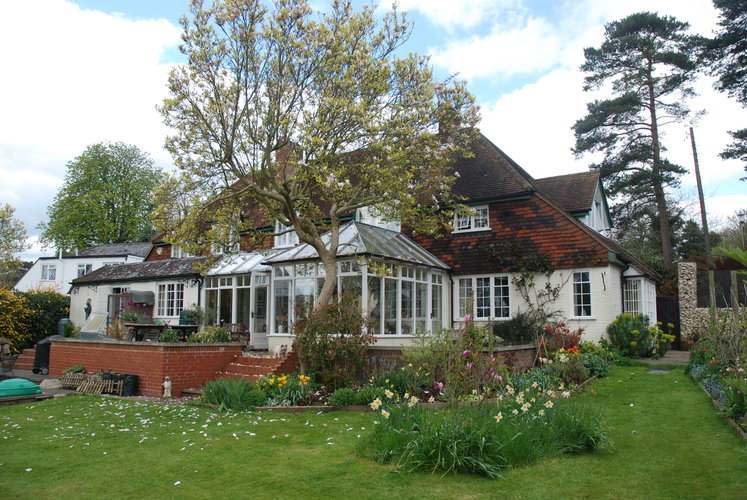 When we bought the house in 1979 we were told that it had been built
for Hon Evelyn Irby by her brother and that the family home had been
across the road in Hitcham Grange. We found out she was a sculptress
and assume the odd bits of work we found around the garden were
probably of her making. That was all we knew until one day about
fifteen years ago, Evelyn's great niece knocked on the door to say she
remembered visiting here as a child. Her mother was Isabel, daughter of
Evelyn's brother, Greville. We spent the next couple of hours walking
around the house and garden as she reminisced. She told me that Evelyn
had trained at the Slade School of Art and wanted to follow a career in
Art but the family preferred her to marry and therefore secure herself
financially. She never married and continued sculpting but only as a
hobby, so it looks like a bit of a compromise.
For the Taplow Moments Book Nigel and I worked out her family tree.
George Florance Irby (1860-1941) the 6th Baron Boston married Cecilia
Irby but they had no children. They lived at Hedsor House.
George's brother Cecil Saumarez Irby (1862- 1935) married Florence
Augusta Upton Cottrell Dorma (1862-1947) and they lived at Hitcham
Grange. They had three children:
- Evelyn Augusta Irby (25th September 1887-1970) who never married.
-Greville Northey Irby, 7th Baron Boston (1889-1958) who married
Constance Lester and had three daughters: Rachel Elizabeth Irby (b1914)
Isobel Caroline Irby (b1917) Christian Florence Irby (1921-97).
-Cecil Eustace Irby, 8th Baron Boston (1897-1972) who never married or
had any children.
On a visit to St Nicholas Church, Hedsor, on one of the parish open
days we found the grave of Evelyn. We also found out how closely linked
the Irby family is to the church. We had a long chat with a relative
and were delighted when a few days later the daughter of Rachel,
Greville's eldest daughter, phoned up. She said she had fond memories
of visiting The Orchard as a child with her mother. Like her cousin,
visiting with her mother Isabel, Evelyn is remembered as a lovely aunt.
Both great nieces recall some rather lively conversations about the
unfairness of the English inheritance law of primogeniture. Evelyn was
the eldest child of Cecil Saumarez Irby, younger brother and heir to
the 6th Baron Boston. As a girl she would inherit nothing but be
expected to "marry well". Her younger brothers would in turn become
Baron Boston and live at Hedsor House. As neither of them had sons the
title and House would pass over Rachel and Isobel and go to a distant
nephew.
The family story confirmed what we had been told, that Evelyn's brother
Greville, by now Baron Boston, had paid to have the house built for his
spinster sister.
I dug out the deeds to the house to see if we could find some more
facts to go with these bits of information.
The first document was the conveyance of Phipps Orchard to Evelyn Irby
dated 17th 0ctober 1935. It explained that by the time of his death on
21st February 1935, Cecil Saumarez Irby of Hitcham Grange had
re-mortgaged the Grange and lands several times and the sum had now
reached £8,300.
His will appointed his wife Florence, Hon Gilbert Neville Irby and his
son Greville Northey Irby as his executors.
In order to pay off the mortgage they decided to sell Hitcham Grange,
as none of the family lived there anymore. On the conveyance the
address of Evelyn's mother was given as Rockwells, Beaconsfield and
that of Evelyn as Old Lodge Cottage, Taplow. Her brother Greville was
living in Putney. Lord Desborough agreed to buy The Grange along with
other parcels of land. He immediately sold back Phipps Orchard for
£200. In the conveyance of Phipps Orchard, it stipulated that only one
private dwelling was to be allowed on the land. Much of the rest of the
conveyance was taken up by what was to happen to the waste water
soakaway from Hitcham Grange which came under the road and into the
orchard. Before mains drains this was a major issue.
We uncovered the soakaway once by accident. It is brick built and
circular in construction probably dating from the mid-19th Century and
beautifully built. Nowadays it lives under the compost heaps with its
lid firmly stuck on.
Evelyn took up residence in 1937 and the house was very much a
residence for a lady. There was a maid's room off the kitchen and,
although the house was quite small, each room had a bell button to call
the maid. The bell box in the kitchen is still there and working. It is
used now mainly by the grand children to get the dogs barking. The
kitchen was plain and functional and at the front of the house so the
maid had no view into the back garden. The size of the house and number
of rooms was sufficient for one person to be comfortable. There were
oak floors and arches. Shutters on the doors inside and shutters on the
windows outside. It also had central heating which was very much a
luxury at that time. An added touch and Evelyn's favourite was the
balcony where she could lose herself in her sculpting. When we moved
into The Orchard in 1979, the son-in-law of our neighbour, Jean Burley,
told us about his childhood memories of Miss Irby in 1950's. She was a
recluse by then and well known in the village for her brass telescope
which she kept on the balcony. He and his school friends would see it
glinting in the sunshine as she swung it around to observe what was
going on.
A year after the house was finished a compulsory purchase order arrived
from Bucks County Council. They needed to do some road widening because
of traffic congestion. At that time, the driveway of Hitcham Grange
came out facing the top end of High Street. The Council wanted the
corner piece of land where High Street and Hill Farm Road met. Evelyn
was paid £11 and the new cleft oak fence and front gates she had just
had erected were re-sited in compensation. The oak fence is still there
today although we have been through a few front gates. It is probably
at this time that the Scots Pines were planted as they follow the line
of the new fence. There were five when we moved in but we are down to
three now.
The next document is a modifying Covenant dated 17th October 1953,
drawn up between Evelyn and her brother now Baron Boston. Consent is
given to allow another dwelling on the site of The Orchard.
The reason is explained in a deed of conveyance dated 9th February
1954, four months later. It is for the sale for £525 of the south part
of The Orchard garden to Arthur Kitchener of The Lodge, Hitcham Grange,
whose profession is given as decorator. One of the witnesses is Maud
Rosanna Brown, widow, living at The Orchard.
This confirms what Evelyn's great nieces told me. They said that later
in life Evelyn became quite frail and had a paid companion living with
her. They also said that the lower part of the garden was sold off to
the gardener/odd job man with the idea that he and his wife would be
close to help out. This also would explain the gate in the fence
between the two gardens.
Like the first sale, much is written about the rights of access and
maintenance of waste pipes and over flows but this time it is from
Hitcham Grange Lodge and Hill Farm and flowed into the south part of
The Orchard garden.
It was not many years after this that Evelyn was too frail to live at
home and went to live in a nursing home in Hampshire. Neither niece can
understand why she went so far from her home and family. The house was
sold in 1961 to pay for the fees and Evelyn lived another 9 years dying
in 1970.
We have the advert placed in Country Life Magazine, for the sale at
auction of The Orchard, on Wednesday 18th October 1961. It was sold
with conditional permission for the erection of a dwelling house in the
garden.
On 16th November 1961, it was bought by Arthur Denis Blachford Wood and
Mrs Margaret Jean Wood. The Conveyance states they paid £7,250. Hoping
to get back some of the money they had invested, Denis and Margaret
must have been very annoyed when in 1965 they applied to build a house
in the garden but had permission refused. They tried and failed again
in 1974.
There is a land transfer document dated 5th May 1964 which has a very
sad story. The rectangle of the land that ran alongside Old Lodge East
next to The Orchard belonged to Old Lodge. It had always been boggy,
often a pond and used as a soakaway for Old Lodge. The Martineau family
were living there at the time. One day their little child was found
drowned in the pond. One can only imagine the heartbreak. Soon after
this Charles Edmund Martineau sold the land to Denis and Margaret. The
transfer stipulated that the buyers were to build a seven foot high
brick wall on the new boundary and brick up the door from the Old Lodge
apple store. The tragic memory was to be blocked out. It made the
garden of The Orchard into a sensible shape now but what a horrid way
for it to come about. The wall is still there with two niches. One
holds the bust of an elegant Edwardian lady and the other a bust of a
youth of about nine. We like to think these are the work of Evelyn.
When we bought the house in 1979 we were told that it had been built
for Hon Evelyn Irby by her brother and that the family home had been
across the road in Hitcham Grange. We found out she was a sculptress
and assume the odd bits of work we found around the garden were
probably of her making. That was all we knew until one day about
fifteen years ago, Evelyn's great niece knocked on the door to say she
remembered visiting here as a child. Her mother was Isabel, daughter of
Evelyn's brother, Greville. We spent the next couple of hours walking
around the house and garden as she reminisced. She told me that Evelyn
had trained at the Slade School of Art and wanted to follow a career in
Art but the family preferred her to marry and therefore secure herself
financially. She never married and continued sculpting but only as a
hobby, so it looks like a bit of a compromise.
For the Taplow Moments Book Nigel and I worked out her family tree.
George Florance Irby (1860-1941) the 6th Baron Boston married Cecilia
Irby but they had no children. They lived at Hedsor House.
George's brother Cecil Saumarez Irby (1862- 1935) married Florence
Augusta Upton Cottrell Dorma (1862-1947) and they lived at Hitcham
Grange. They had three children:
- Evelyn Augusta Irby (25th September 1887-1970) who never married.
-Greville Northey Irby, 7th Baron Boston (1889-1958) who married
Constance Lester and had three daughters: Rachel Elizabeth Irby (b1914)
Isobel Caroline Irby (b1917) Christian Florence Irby (1921-97).
-Cecil Eustace Irby, 8th Baron Boston (1897-1972) who never married or
had any children.
On a visit to St Nicholas Church, Hedsor, on one of the parish open
days we found the grave of Evelyn. We also found out how closely linked
the Irby family is to the church. We had a long chat with a relative
and were delighted when a few days later the daughter of Rachel,
Greville's eldest daughter, phoned up. She said she had fond memories
of visiting The Orchard as a child with her mother. Like her cousin,
visiting with her mother Isabel, Evelyn is remembered as a lovely aunt.
Both great nieces recall some rather lively conversations about the
unfairness of the English inheritance law of primogeniture. Evelyn was
the eldest child of Cecil Saumarez Irby, younger brother and heir to
the 6th Baron Boston. As a girl she would inherit nothing but be
expected to "marry well". Her younger brothers would in turn become
Baron Boston and live at Hedsor House. As neither of them had sons the
title and House would pass over Rachel and Isobel and go to a distant
nephew.
The family story confirmed what we had been told, that Evelyn's brother
Greville, by now Baron Boston, had paid to have the house built for his
spinster sister.
I dug out the deeds to the house to see if we could find some more
facts to go with these bits of information.
The first document was the conveyance of Phipps Orchard to Evelyn Irby
dated 17th 0ctober 1935. It explained that by the time of his death on
21st February 1935, Cecil Saumarez Irby of Hitcham Grange had
re-mortgaged the Grange and lands several times and the sum had now
reached £8,300.
His will appointed his wife Florence, Hon Gilbert Neville Irby and his
son Greville Northey Irby as his executors.
In order to pay off the mortgage they decided to sell Hitcham Grange,
as none of the family lived there anymore. On the conveyance the
address of Evelyn's mother was given as Rockwells, Beaconsfield and
that of Evelyn as Old Lodge Cottage, Taplow. Her brother Greville was
living in Putney. Lord Desborough agreed to buy The Grange along with
other parcels of land. He immediately sold back Phipps Orchard for
£200. In the conveyance of Phipps Orchard, it stipulated that only one
private dwelling was to be allowed on the land. Much of the rest of the
conveyance was taken up by what was to happen to the waste water
soakaway from Hitcham Grange which came under the road and into the
orchard. Before mains drains this was a major issue.
We uncovered the soakaway once by accident. It is brick built and
circular in construction probably dating from the mid-19th Century and
beautifully built. Nowadays it lives under the compost heaps with its
lid firmly stuck on.
Evelyn took up residence in 1937 and the house was very much a
residence for a lady. There was a maid's room off the kitchen and,
although the house was quite small, each room had a bell button to call
the maid. The bell box in the kitchen is still there and working. It is
used now mainly by the grand children to get the dogs barking. The
kitchen was plain and functional and at the front of the house so the
maid had no view into the back garden. The size of the house and number
of rooms was sufficient for one person to be comfortable. There were
oak floors and arches. Shutters on the doors inside and shutters on the
windows outside. It also had central heating which was very much a
luxury at that time. An added touch and Evelyn's favourite was the
balcony where she could lose herself in her sculpting. When we moved
into The Orchard in 1979, the son-in-law of our neighbour, Jean Burley,
told us about his childhood memories of Miss Irby in 1950's. She was a
recluse by then and well known in the village for her brass telescope
which she kept on the balcony. He and his school friends would see it
glinting in the sunshine as she swung it around to observe what was
going on.
A year after the house was finished a compulsory purchase order arrived
from Bucks County Council. They needed to do some road widening because
of traffic congestion. At that time, the driveway of Hitcham Grange
came out facing the top end of High Street. The Council wanted the
corner piece of land where High Street and Hill Farm Road met. Evelyn
was paid £11 and the new cleft oak fence and front gates she had just
had erected were re-sited in compensation. The oak fence is still there
today although we have been through a few front gates. It is probably
at this time that the Scots Pines were planted as they follow the line
of the new fence. There were five when we moved in but we are down to
three now.
The next document is a modifying Covenant dated 17th October 1953,
drawn up between Evelyn and her brother now Baron Boston. Consent is
given to allow another dwelling on the site of The Orchard.
The reason is explained in a deed of conveyance dated 9th February
1954, four months later. It is for the sale for £525 of the south part
of The Orchard garden to Arthur Kitchener of The Lodge, Hitcham Grange,
whose profession is given as decorator. One of the witnesses is Maud
Rosanna Brown, widow, living at The Orchard.
This confirms what Evelyn's great nieces told me. They said that later
in life Evelyn became quite frail and had a paid companion living with
her. They also said that the lower part of the garden was sold off to
the gardener/odd job man with the idea that he and his wife would be
close to help out. This also would explain the gate in the fence
between the two gardens.
Like the first sale, much is written about the rights of access and
maintenance of waste pipes and over flows but this time it is from
Hitcham Grange Lodge and Hill Farm and flowed into the south part of
The Orchard garden.
It was not many years after this that Evelyn was too frail to live at
home and went to live in a nursing home in Hampshire. Neither niece can
understand why she went so far from her home and family. The house was
sold in 1961 to pay for the fees and Evelyn lived another 9 years dying
in 1970.
We have the advert placed in Country Life Magazine, for the sale at
auction of The Orchard, on Wednesday 18th October 1961. It was sold
with conditional permission for the erection of a dwelling house in the
garden.
On 16th November 1961, it was bought by Arthur Denis Blachford Wood and
Mrs Margaret Jean Wood. The Conveyance states they paid £7,250. Hoping
to get back some of the money they had invested, Denis and Margaret
must have been very annoyed when in 1965 they applied to build a house
in the garden but had permission refused. They tried and failed again
in 1974.
There is a land transfer document dated 5th May 1964 which has a very
sad story. The rectangle of the land that ran alongside Old Lodge East
next to The Orchard belonged to Old Lodge. It had always been boggy,
often a pond and used as a soakaway for Old Lodge. The Martineau family
were living there at the time. One day their little child was found
drowned in the pond. One can only imagine the heartbreak. Soon after
this Charles Edmund Martineau sold the land to Denis and Margaret. The
transfer stipulated that the buyers were to build a seven foot high
brick wall on the new boundary and brick up the door from the Old Lodge
apple store. The tragic memory was to be blocked out. It made the
garden of The Orchard into a sensible shape now but what a horrid way
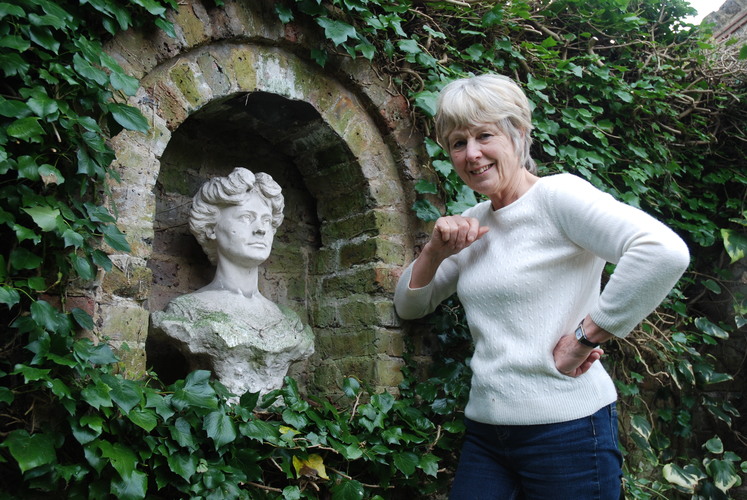
for it to come about. The wall is still there with two niches. One
holds the bust of an elegant Edwardian lady and the other a bust of a
youth of about nine. We like to think these are the work of Evelyn.
 Denis and Margaret continued to live here for another ten years. During
which time Denis worked the garden. He was not a great one for
gardening himself and why need he be? He had staff to plant out his
ideas for him as he was the great grandson of William Wood and now head
of the family firm. By this time, the nursery for William Wood and Son
was by Taplow station. It was described as 'Royal Horticulturists and
Garden Designers and Contractors" and had some very aristocratic and
affluent clients.
After graduating from Magdalen College, Oxford, in 1929, he had joined
the family business. His speciality was garden design and while running
the business he started writing. Several photos of different aspects of
the garden pop up in his books and we still have many plants from his
time here. Over the years we have redeveloped the garden. The landscape
designer, Graham Bell, was delighted to find he was working in the
garden of one of his mentors. For he had worked for Denis at the
William Woods nursery as a youngster. He said he had a collection of
books written by Denis which were much thumbed.
Denis had no son to pass the company on to as his two daughters had
followed other careers. Ann, I know became a vet. So he sold the
company when he retired in the 1960s. The nursery has changed a lot
since then and is now part of Land Securities, trading as the Bishops
Centre. Not many plants for sale there nowadays. Denis and Margaret
moved back to Oxford to be close to the academic life Denis loved. The
Orchard was sold on 4th July 1975 to Timothy and Mary Brighouse for
£29,700.
Tim had just started a job in the education department for
Buckinghamshire County Council. His is a household name to anyone
involved in education and he was knighted in 2009.
In 1975 in his mid- thirties he was already going places. He had not
been here long before he was head hunted for the job of Chief Education
Officer for Oxford, which meant a long drive up the M 40 every day. The
garden was described to Tim and Mary as low maintenance and Tim said he
had hoped it meant next to no maintenance but what with two young
children, a demanding job and lots of travel the garden began to
disappear under the ivy and brambles. By 1979 he and Mary had had
enough and the family moved to Oxford and the Orchard was on the market
again.
Denis and Margaret continued to live here for another ten years. During
which time Denis worked the garden. He was not a great one for
gardening himself and why need he be? He had staff to plant out his
ideas for him as he was the great grandson of William Wood and now head
of the family firm. By this time, the nursery for William Wood and Son
was by Taplow station. It was described as 'Royal Horticulturists and
Garden Designers and Contractors" and had some very aristocratic and
affluent clients.
After graduating from Magdalen College, Oxford, in 1929, he had joined
the family business. His speciality was garden design and while running
the business he started writing. Several photos of different aspects of
the garden pop up in his books and we still have many plants from his
time here. Over the years we have redeveloped the garden. The landscape
designer, Graham Bell, was delighted to find he was working in the
garden of one of his mentors. For he had worked for Denis at the
William Woods nursery as a youngster. He said he had a collection of
books written by Denis which were much thumbed.
Denis had no son to pass the company on to as his two daughters had
followed other careers. Ann, I know became a vet. So he sold the
company when he retired in the 1960s. The nursery has changed a lot
since then and is now part of Land Securities, trading as the Bishops
Centre. Not many plants for sale there nowadays. Denis and Margaret
moved back to Oxford to be close to the academic life Denis loved. The
Orchard was sold on 4th July 1975 to Timothy and Mary Brighouse for
£29,700.
Tim had just started a job in the education department for
Buckinghamshire County Council. His is a household name to anyone
involved in education and he was knighted in 2009.
In 1975 in his mid- thirties he was already going places. He had not
been here long before he was head hunted for the job of Chief Education
Officer for Oxford, which meant a long drive up the M 40 every day. The
garden was described to Tim and Mary as low maintenance and Tim said he
had hoped it meant next to no maintenance but what with two young
children, a demanding job and lots of travel the garden began to
disappear under the ivy and brambles. By 1979 he and Mary had had
enough and the family moved to Oxford and the Orchard was on the market
again.
 We were living in a village in Somerset at the time and loved it. Keith
had to move back to London for work and the thought of urban life did
not appeal. We had spent nine months travelling to the suburbs all
around London getting more and more depressed. Everything was so very
expensive and anything we liked was often sold before we could get up
to see it. It was the era of "Gazumping" and house prices were going
mad. We wanted to live in a village with a school, near a station. It
looked like an impossible dream until one day driving back from
Beaconsfield we came through Taplow. With three young children in the
back getting very bored and yet another day spent viewing a string of
houses that were modern boxes or just sold, we were not in the best of
moods. Keith mentioned that the estate agent had said a house in Taplow
might be coming back on the market the following Monday. It was called
The Orchard. We drove around and could not find it and Keith exploded
"That's it! We're going home." We were just reversing around a corner
when our son Chris pipes up, "That house is called The Orchard". I got
out and peered through the holly hedge. The garden looked promisingly
big. We walked to the front gate and saw Tim standing in the garden. We
asked him if the house was on the market. He said that it would be the
following Monday, as the sale had fallen through. The house was empty.
He had just come over from Oxford to get it ready to go back on the
market, so we were lucky to find any one there. He asked us if we would
like to see round. The garden was quite overgrown but it was large. The
house needed a lot of refurbishment as very little had changed since it
had been built. We did not care. We bought it there and then. The house
that had been built for one lady and her maid now would have to
accommodate a couple with two boys of seven and eight, a girl of two
and two Labrador dogs. It was going to be a squeeze but it had half an
acre of land and we loved the place from the moment we saw it.
The house became ours on 28th September 1979 for £69,500. That autumn
we set about clearing away the brambles and pruning back the most
rampant shrubs. We had some wonderful bonfires. In the process we
discovered that the garden was very much bigger than we had thought.
Chris was happy once he found that there was more than enough room for
a cricket wicket on the lawn. He and brother Graeme had played cricket
in the garden all the time in Somerset. However, the boys were very
cross when we cut down one of the old apple trees which had a rope
swing, to make space for a vegetable garden. There were plenty of other
old apple trees still left from the days of Phipps Orchard but none of
them had the swing potential of this one. I am cross we did it too, now
I think of it. We had to wait another fifteen years for the walnut
sapling growing in the lawn to grow big enough to become the new rope
swing tree.
One day soon after we had moved in, Keith was cutting back the wisteria
on the back wall of the house. He called out that he had found a
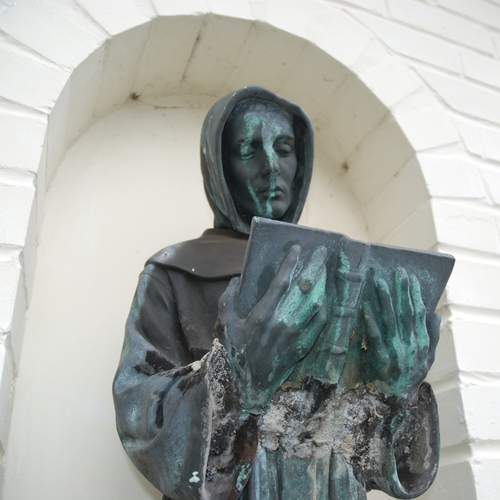
sitting tenant. There standing in a four foot niche in the wall was a
beautiful statue of a monk reading a book. We did not evict him and he
lives with us still.
The garden was dotted with old apple trees when we moved in but over 46
years one by one they have died from disease or old age, fallen or been
blown over. The rope swing tree was the only one we wilfully chopped
down. We have just lost the last one when it keeled over in the summer.
We have planted several more fruit trees recently as someone pointed
out that we could hardly call the property The Orchard without having
fruit trees in it.
One of our discoveries early on was the septic tank for The Orchard
hidden under loads of brambles. Not so beautifully made as the Hitcham
Grange one, next to it, and now defunct. Mains drains came to Taplow
just before we moved in to what we heard was great local joy. No more
worries about where the sewage was going or the need for long
paragraphs on the subject in future conveyances.
The house has developed over the years we have been here. First to
change was the kitchen. No longer the domain of a maid but a space much
used by the family. The maid's room, used by Denis as a study, became
the perfect utility room. Eventually, the whole area was enlarged and
the bedroom above made bigger. Much later the east end of the house was
pushed out. A new lounge replaced the garage and an office was built
next door and a bedroom above. A conservatory runs along the back of
the house and a lovely sun trap. However, the main core of the original
house is still there and many features from that time have been
incorporated into the new parts. I hope no one can spot the joins.
Julia Paskins
We were living in a village in Somerset at the time and loved it. Keith
had to move back to London for work and the thought of urban life did
not appeal. We had spent nine months travelling to the suburbs all
around London getting more and more depressed. Everything was so very
expensive and anything we liked was often sold before we could get up
to see it. It was the era of "Gazumping" and house prices were going
mad. We wanted to live in a village with a school, near a station. It
looked like an impossible dream until one day driving back from
Beaconsfield we came through Taplow. With three young children in the
back getting very bored and yet another day spent viewing a string of
houses that were modern boxes or just sold, we were not in the best of
moods. Keith mentioned that the estate agent had said a house in Taplow
might be coming back on the market the following Monday. It was called
The Orchard. We drove around and could not find it and Keith exploded
"That's it! We're going home." We were just reversing around a corner
when our son Chris pipes up, "That house is called The Orchard". I got
out and peered through the holly hedge. The garden looked promisingly
big. We walked to the front gate and saw Tim standing in the garden. We
asked him if the house was on the market. He said that it would be the
following Monday, as the sale had fallen through. The house was empty.
He had just come over from Oxford to get it ready to go back on the
market, so we were lucky to find any one there. He asked us if we would
like to see round. The garden was quite overgrown but it was large. The
house needed a lot of refurbishment as very little had changed since it
had been built. We did not care. We bought it there and then. The house
that had been built for one lady and her maid now would have to
accommodate a couple with two boys of seven and eight, a girl of two
and two Labrador dogs. It was going to be a squeeze but it had half an
acre of land and we loved the place from the moment we saw it.
The house became ours on 28th September 1979 for £69,500. That autumn
we set about clearing away the brambles and pruning back the most
rampant shrubs. We had some wonderful bonfires. In the process we
discovered that the garden was very much bigger than we had thought.
Chris was happy once he found that there was more than enough room for
a cricket wicket on the lawn. He and brother Graeme had played cricket
in the garden all the time in Somerset. However, the boys were very
cross when we cut down one of the old apple trees which had a rope
swing, to make space for a vegetable garden. There were plenty of other
old apple trees still left from the days of Phipps Orchard but none of
them had the swing potential of this one. I am cross we did it too, now
I think of it. We had to wait another fifteen years for the walnut
sapling growing in the lawn to grow big enough to become the new rope
swing tree.
One day soon after we had moved in, Keith was cutting back the wisteria
on the back wall of the house. He called out that he had found a
sitting tenant. There standing in a four foot niche in the wall was a
beautiful statue of a monk reading a book. We did not evict him and he
lives with us still.
The garden was dotted with old apple trees when we moved in but over 46
years one by one they have died from disease or old age, fallen or been
blown over. The rope swing tree was the only one we wilfully chopped
down. We have just lost the last one when it keeled over in the summer.
We have planted several more fruit trees recently as someone pointed
out that we could hardly call the property The Orchard without having
fruit trees in it.
One of our discoveries early on was the septic tank for The Orchard
hidden under loads of brambles. Not so beautifully made as the Hitcham
Grange one, next to it, and now defunct. Mains drains came to Taplow
just before we moved in to what we heard was great local joy. No more
worries about where the sewage was going or the need for long
paragraphs on the subject in future conveyances.
The house has developed over the years we have been here. First to
change was the kitchen. No longer the domain of a maid but a space much
used by the family. The maid's room, used by Denis as a study, became
the perfect utility room. Eventually, the whole area was enlarged and
the bedroom above made bigger. Much later the east end of the house was
pushed out. A new lounge replaced the garage and an office was built
next door and a bedroom above. A conservatory runs along the back of
the house and a lovely sun trap. However, the main core of the original
house is still there and many features from that time have been
incorporated into the new parts. I hope no one can spot the joins.
Julia Paskins