
Archived Page
This page is no longer maintained.
For up-to-date information please see the
new website
Dropmore House
A group of Taplow residents were invited to meet with the team of architects and planners who are intending to correct the disaster that the previous developers made of the Dropmore site. The intention of the meeting was to ensure that the local people were fully aware and supportive of what they are trying to do with this much abused building and its once great gardens and to ask for help in their extensive research as to what was once there. They would be interested in old photographs or pictures of the house and gardens. The firm of Giles Quarm & Associates in collaboration with Quinlan & Francis Terry (who are the main architects) are leading the attempt to finally restore the old house and its gardens to its proper state and purpose, which is to be an elegant private home. The previous developers only saw this site as a way to make money with a complete disregard for its history and architecture, and left a frightful shambles behind when they went bust. At the meeting, which was followed by a site visit, we saw the full extent of the disaster. Before the serious restoration work can begin all the new additions tacked onto the house have to be taken down. That will probably take at least 18 months. An enormous effort is being made to research what was originally there, both in the house and gardens, so that they can be restored to their former glory and become a beautiful home once more. This is being done with money no object. A small new building to house guests will be built elsewhere in the grounds to a design by Samuel Wyatt, Dropmore's original architect. It is difficult to describe the desolation of the site and many photographs would be needed to show the scale of it.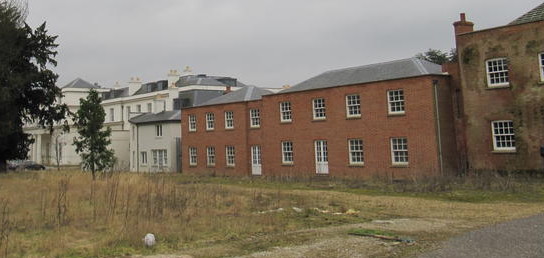 For those not familiar with the recent history, the main house was
burned down on two occasions by arsonists, but enough remained of the
main structures to make restoration worthwhile. The estate used to
boast huge beautiful gardens and a pinetum, now sadly neglected for
many years. It is estimated that it could take about 20 years to
restore. These gardens were once one of the greatest in England and
Queen Victoria was an occasional visitor. We have seen the astonishing
transformation of Taplow Court by its present owners SGI and it looks
as though Dropmore has found a similar white knight to rescue it.
For those not familiar with the recent history, the main house was
burned down on two occasions by arsonists, but enough remained of the
main structures to make restoration worthwhile. The estate used to
boast huge beautiful gardens and a pinetum, now sadly neglected for
many years. It is estimated that it could take about 20 years to
restore. These gardens were once one of the greatest in England and
Queen Victoria was an occasional visitor. We have seen the astonishing
transformation of Taplow Court by its present owners SGI and it looks
as though Dropmore has found a similar white knight to rescue it.
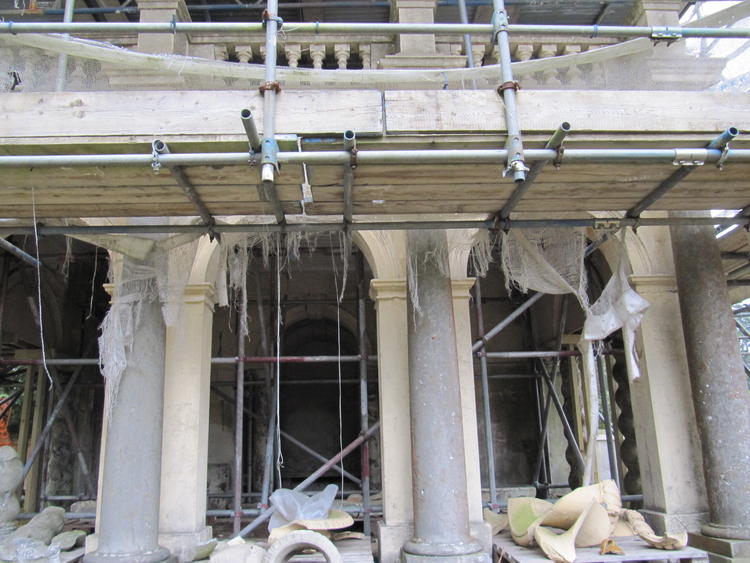 The house is in the centre of a 220 acre estate, a plot so large that
it spans two planning authorities, South Bucks and Wycombe District.
The parish boundary between Burnham and Taplow actually runs through
the house, which has been a grade 1 listed building since 1955. It was
initially built in 1792–5 by Samuel Wyatt for Lord Grenville with
alterations 1806–9 by Charles Tatham.
The gardens, pinetum and plantations were designed and planted by Lord
and Lady Grenville.
The English Heritage Register of Parks and Gardens of Special Historic Interest describes their development:
The house is in the centre of a 220 acre estate, a plot so large that
it spans two planning authorities, South Bucks and Wycombe District.
The parish boundary between Burnham and Taplow actually runs through
the house, which has been a grade 1 listed building since 1955. It was
initially built in 1792–5 by Samuel Wyatt for Lord Grenville with
alterations 1806–9 by Charles Tatham.
The gardens, pinetum and plantations were designed and planted by Lord
and Lady Grenville.
The English Heritage Register of Parks and Gardens of Special Historic Interest describes their development:
Lord Grenville, Prime Minister to George III, began work on the
Dropmore estate in 1792, having bought 15 hectares of land complete
with a small labourer's cottage, which he demolished, then employing
Samuel Wyatt to build the south range of the present house. Grenville
wrote to his future wife, Anne Pitt, 'I think you will be pleased with
the situation when you see it, though I know Lord Camelford will think
it a great deal too exposed. I do not think that a great objection,
being compensated, as it is, by the advantage of air and prospect'
(Country Life 1956). Grenville began landscaping Dropmore immediately
after he built the house, and his improvements are said to have
included the removal of a hill that blocked the view of Windsor Castle
12 kilometres to the south-east (Country Life 1956). He was a keen
botanist, and planted many trees, some supplied by his brother Lord
Buckingham from Stowe, including, in the 1820s, a 25 hectare pinetum
west of the house, around the lake. Grenville died in 1834, leaving his
widow, also a keen botanist, who continued to develop the estate and
gardens, constructing the alcove by the lake, and probably the
Italianate features in the walled garden. Following Lady Grenville's
death in 1864, aged ninety-one, the estate was inherited by the
Fortescue family, and bought in 1943 by Lord Kemsley. Following its
occupation by the Army during the Second World War, and consequent
deterioration of the house and grounds, the Kemsleys restored the
estate and planted many more trees to complement the existing planting.
The majority of the house burnt down in 1990, and has not been rebuilt,
although there are plans to do so (1997). Much of the garden has
subsequently been vandalised and many structures have been stolen. The
site remains (1997) in private ownership.
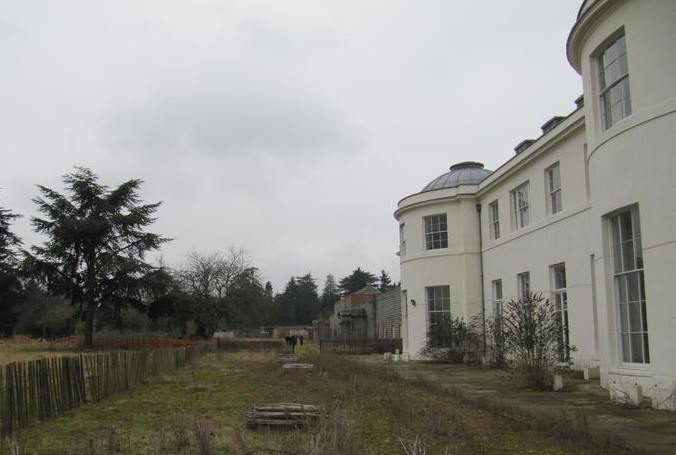
The main two-storey house lies towards the north end of the site. It is
built in Classical style of rendered and colour-washed cement, with a
central single-storey portico on the north entrance front. The south
garden front has three bows with shallow domed roofs. The ground floor
garden front supports a wooden trellis-work pergola at the west end,
with arched openings in front of each window. (See photo as it is now!)
It used also to support an enclosed verandah in similar style at the
east end (now long gone).
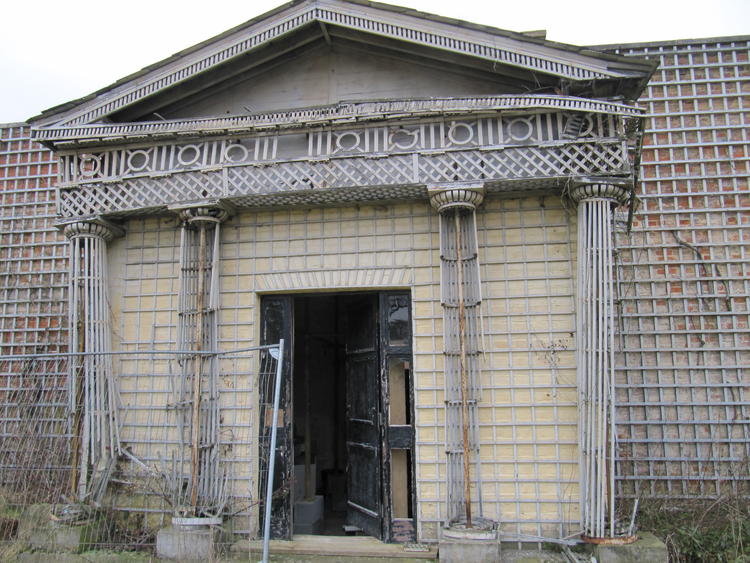 The house was seriously damaged by the 1990 fire which left only its
west wing standing. A modern house has been added on the west elevation
of this remnant. Beyond that are two walled courts side-by-side. The
first is a service court; on its south wall is a small lean-to building
with an overhanging slate roof supported on decorative iron
trellis-work pillars. Two low towers flank the brick piers of a gate
leading to the second court, a severe early-19th century red-brick
stable court with its main access from the rear drive through a tall
arch on the north side.
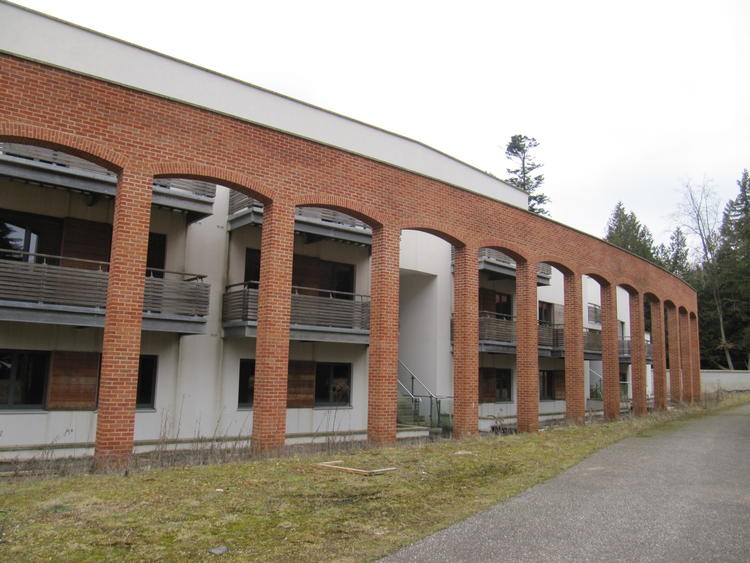
The proposed works will return the house to being a single residence,
and include the removal of all the alterations made by the last owners
and the demolition of a large new unfinished building immediately
adjacent to the main building – the block of modern flats. The historic
listed garden structures are to be restored to protect and enhance the
setting of the house, with woodland on the periphery. The cost of
restoring the aviary alone will be £1m. Oak Lodge will be one of the
last buildings to be restored. The intention is to use it to house an
estate worker.
We have put in a plea to move the ugly mesh fence back from its current
position and to replace it with something more visually attractive, and
have suggested that we be given a footpath alongside the boundary.
We wish the current owner well with his restoration work and look
forward to seeing it rise like the phoenix from the sorry state which
it is in today.
Eva Lipman and Fred Russell
The house was seriously damaged by the 1990 fire which left only its
west wing standing. A modern house has been added on the west elevation
of this remnant. Beyond that are two walled courts side-by-side. The
first is a service court; on its south wall is a small lean-to building
with an overhanging slate roof supported on decorative iron
trellis-work pillars. Two low towers flank the brick piers of a gate
leading to the second court, a severe early-19th century red-brick
stable court with its main access from the rear drive through a tall
arch on the north side.
The proposed works will return the house to being a single residence,
and include the removal of all the alterations made by the last owners
and the demolition of a large new unfinished building immediately
adjacent to the main building – the block of modern flats. The historic
listed garden structures are to be restored to protect and enhance the
setting of the house, with woodland on the periphery. The cost of
restoring the aviary alone will be £1m. Oak Lodge will be one of the
last buildings to be restored. The intention is to use it to house an
estate worker.
We have put in a plea to move the ugly mesh fence back from its current
position and to replace it with something more visually attractive, and
have suggested that we be given a footpath alongside the boundary.
We wish the current owner well with his restoration work and look
forward to seeing it rise like the phoenix from the sorry state which
it is in today.
Eva Lipman and Fred Russell
More pictures
These would not fit in the printed newsletter: The unfinished flats: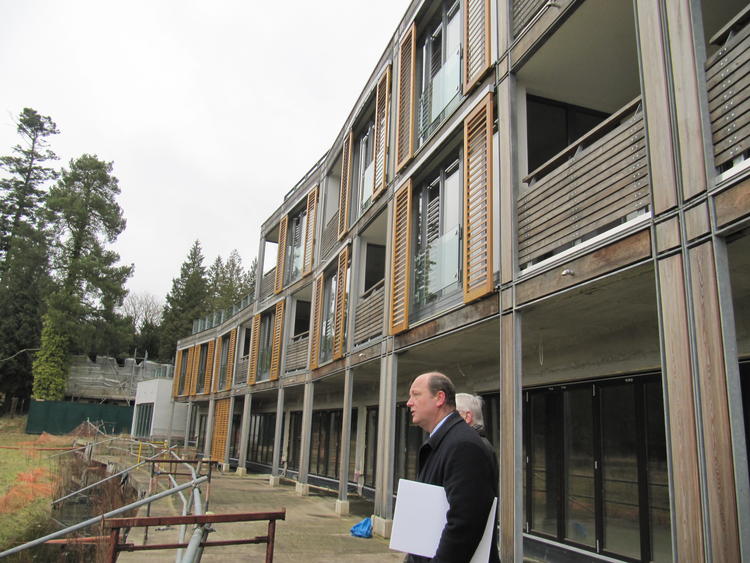
 The garden face of the house in 2013:
 Dropmore looking (briefly) cared-for in 2011:
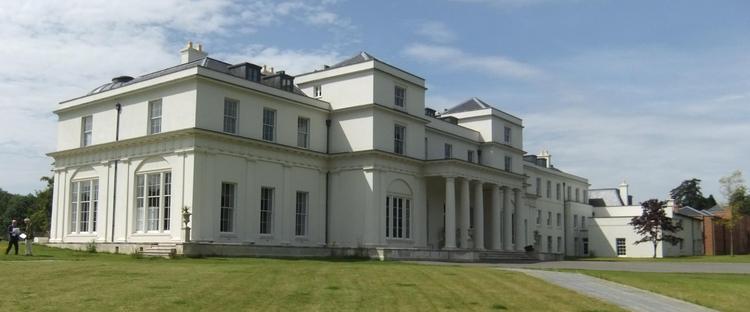 (This picture by Fred Russell, all the others by Eva Lipman)