
Archived Page
This page is no longer maintained.
For up-to-date information please see the
new website
Mill Lane Development
On 26 March, Hunter Page Planning set out a second public exhibition of their plans for the redevelopment of the Mill Lane area. For those of you who missed the exhibition, the majority of the redevelopment is still focussed at the two ends of the site, with a new hotel dominating the southern approach by Maidenhead Bridge and two large areas of residential apartments to the north. One of these, the Severnside site, occupies the parcel of land to the north of the gasometer, and is intended to comprise housing and live/work units; the other is on the old Mill site itself. In total, these will provide 150 dwellings, plus 28 live/work units. Dunloe House, Mill Island House and Glen Island House are all to be retained, the latter two as offices. Sadly, the proposals for a footbridge connecting the Mill site and the island at Boulters Lock have been dropped for financial reasons, although Hunter Page have said that they would be happy to incorporate it if funds can be raised by other parties. The tennis club has also been dropped, which may come as a disappointment to some, but does at least mean that the centre of the site has been kept open for public access. The new hotel, to be built on the old Skindles site by Maidenhead Bridge, has now been increased in size to 150 beds, with conference rooms, bars and restaurants. Parking for 150 cars is provided, and the service entrance will be via the former Mill Lane/A4 junction, with through traffic on and off the A4 using a new junction to be built further to the west of its present site. Your committee met shortly after the exhibition to consider the proposals and to respond to Hunter Page. In principle, the Society welcomes the development, which will replace the present ugly and derelict hotel and industrial buildings. However, we believe the extent of development is still too great for the sites. The hotel, in particular, has attracted strong opposition and criticism from all sides; at seven storeys, it is considered to be far too high and will seriously impair defined Conservation Area views. The large mass of the building and extent of the car-parking area will significantly encroach on the Green Belt. The design seems to lack any quality or empathy with the riverside setting, and although the architect has positioned the taller hotel block away from the bridge, it is still much too dominant. Moreover, its proximity to Maidenhead Bridge, which carries a Grade 1 listing (higher even than the Grade 2* listing of the Brunel railway bridge), means that any development should be subject to very close scrutiny indeed, by both the local authorities and English heritage. The sheer size and extent of the facilities proposed at the new hotel will generate a very high volume of traffic, and there seems to be no provision for cars belonging to employees, or for those who may come to special functions. The proposed service area appears insufficient and may lead to the parking of commercial vehicles in adjacent roads. Residents of Mill Lane have already raised their objections and concerns separately with Hunter Page and have elicited verbal agreement for additional private parking bays and turning circles; they are also trying to negotiate the inclusion of pedestrianised areas and the possible closing-off of Mill Lane to through traffic. Serious reservations have been expressed about the spread and height of the residential blocks of both the Severnside and Mill sites, which rise to six storeys. Currently only the centre of the proposed Severnside site is occupied by buildings, so the new development would cover a much larger area, presenting an unacceptable impact on its setting within the Green Belt. Moreover, both this and the residential development proposed in the flood zone area of the Mill site may contravene Core Strategy policy. The proximity of new building to Glen Island House, which is listed, is overcrowded, awkward and out of scale and results in an undermining of the character of the existing building. The removal of the plan for the footbridge is also regrettable as there will now be no reason for public access through the site, which may result in a closed development and will make the public green space at the north tip of the site even more remote and inaccessible. Clearly, the visual impact on the present riverside setting will be huge: we have suggested to Hunter Page that it might be useful to compare photo montage visuals of the suggested development against existing views, in order to judge this properly. Overall, our view is that the benefits of improvement – and there undoubtedly are some – must be weighed against the protection of the area. When a planning application is finally submitted, it is imperative that it should be for Full (Detailed) Planning and Listed Building Consents, with clear information on all aspects of all buildings. An Outline Application is not acceptable for a development of this scale in a Green Belt site with Conservation Area status and significant listed buildings such as Maidenhead Bridge. Gill Holloway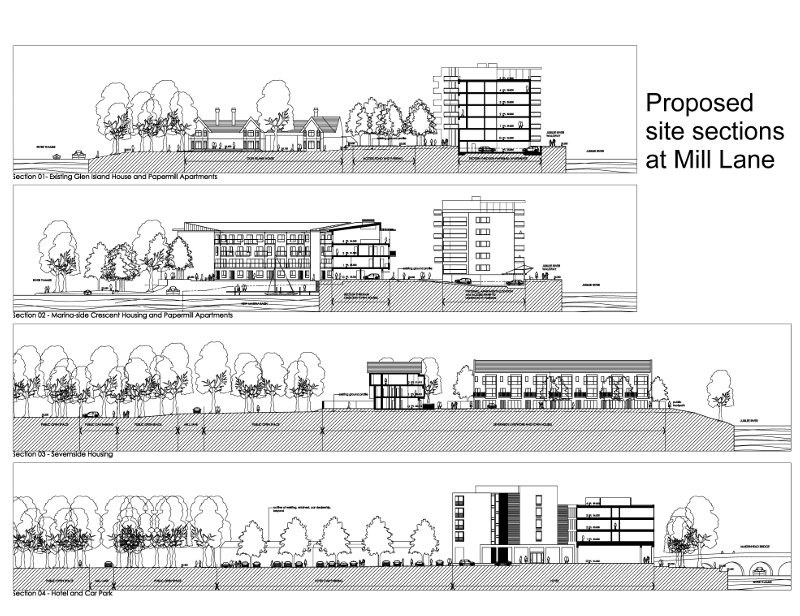 Thanks to Hunter Page Planning for the use of this image.