
Archived Page
This page is no longer maintained.
For up-to-date information please see the
new website
School Walk Round the Village
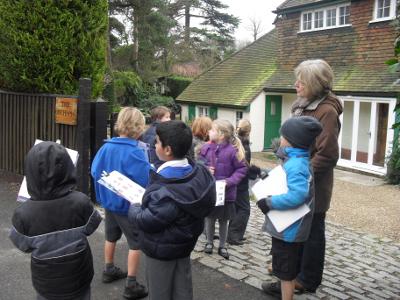 On a couple of cold days in January, groups of six and seven years from St Nicolas' School were seen in Rectory Road and High Street, busy looking at the houses. Their topic for the half term was buildings old and new and they were out spotting what they could find on their own door step.
They found plenty, from the 400-year-old Porches in High Street to the 20th-century houses of Cedar Chase, with every style and era in between. They compared the big house, Maryfield, to the little workers' cottages on the bend of High Street. They looked at the features of the 18th-century Victoria Cottage with its classic Georgian windows and noted the differences to its next door neighbour, The Orchard., which was built in 1937, metal Crittal windows being the order of the day by then.
They found the old shop with little difficulty, as the shop front was a bit of a give-away. With 1805 over its door, some of them worked out that it had been there for over 200 years. They spent a long time looking at the walls, speculating on how the shopkeeper would have used the now-blocked-up doorways and windows. Someone spotted some decoration on the side of Pax Cottage, which they could tick off as Flemish brickwork.
The children recorded all the different types of windows they could find and there were quite a few. They learnt to look skywards to see the detailed eaves window decorations on several of the older houses. One group was very kindly invited into The Mulberries. The children were fascinated to see its 100-year-old servants' quarters and have a go at pushing the bells. Unfortunately no servants responded.
Walking on, they found some very old windows made up of small bits of glass, full of the bubbles and bumps of early glass making. The children worked out that Cedar Chase and their school must be quite modern, as they had large windows with perfectly clear glass by comparison . Also, these buildings do not have chimney pots like the older houses. What fun the children had counting up all the chimney pots they could see from the Village Green. So many of them are magnificent, and beautifully ornate affairs. The children also found that most of the houses are made of tiles and bricks made of clay, for centuries the locally sourced building material of the South East. There are no slate quarries near by and as a result very few slate roofs.
The church has one of them. It was also the only stone building the children saw and one group decided this was because it is a very special place so it needed very special building materials.
The children were supposed to be out for half an hour but they found so much to see that not one group managed their walk in under an hour. How lucky these children are to have such rich resource within walking distance. So much better than reading about it in books or on the internet.
Julia Paskins
On a couple of cold days in January, groups of six and seven years from St Nicolas' School were seen in Rectory Road and High Street, busy looking at the houses. Their topic for the half term was buildings old and new and they were out spotting what they could find on their own door step.
They found plenty, from the 400-year-old Porches in High Street to the 20th-century houses of Cedar Chase, with every style and era in between. They compared the big house, Maryfield, to the little workers' cottages on the bend of High Street. They looked at the features of the 18th-century Victoria Cottage with its classic Georgian windows and noted the differences to its next door neighbour, The Orchard., which was built in 1937, metal Crittal windows being the order of the day by then.
They found the old shop with little difficulty, as the shop front was a bit of a give-away. With 1805 over its door, some of them worked out that it had been there for over 200 years. They spent a long time looking at the walls, speculating on how the shopkeeper would have used the now-blocked-up doorways and windows. Someone spotted some decoration on the side of Pax Cottage, which they could tick off as Flemish brickwork.
The children recorded all the different types of windows they could find and there were quite a few. They learnt to look skywards to see the detailed eaves window decorations on several of the older houses. One group was very kindly invited into The Mulberries. The children were fascinated to see its 100-year-old servants' quarters and have a go at pushing the bells. Unfortunately no servants responded.
Walking on, they found some very old windows made up of small bits of glass, full of the bubbles and bumps of early glass making. The children worked out that Cedar Chase and their school must be quite modern, as they had large windows with perfectly clear glass by comparison . Also, these buildings do not have chimney pots like the older houses. What fun the children had counting up all the chimney pots they could see from the Village Green. So many of them are magnificent, and beautifully ornate affairs. The children also found that most of the houses are made of tiles and bricks made of clay, for centuries the locally sourced building material of the South East. There are no slate quarries near by and as a result very few slate roofs.
The church has one of them. It was also the only stone building the children saw and one group decided this was because it is a very special place so it needed very special building materials.
The children were supposed to be out for half an hour but they found so much to see that not one group managed their walk in under an hour. How lucky these children are to have such rich resource within walking distance. So much better than reading about it in books or on the internet.
Julia Paskins