Archived Page
This page is no longer maintained.
For up-to-date information please see the
new website
Taplow House Hotel - A Gardener's Perspective
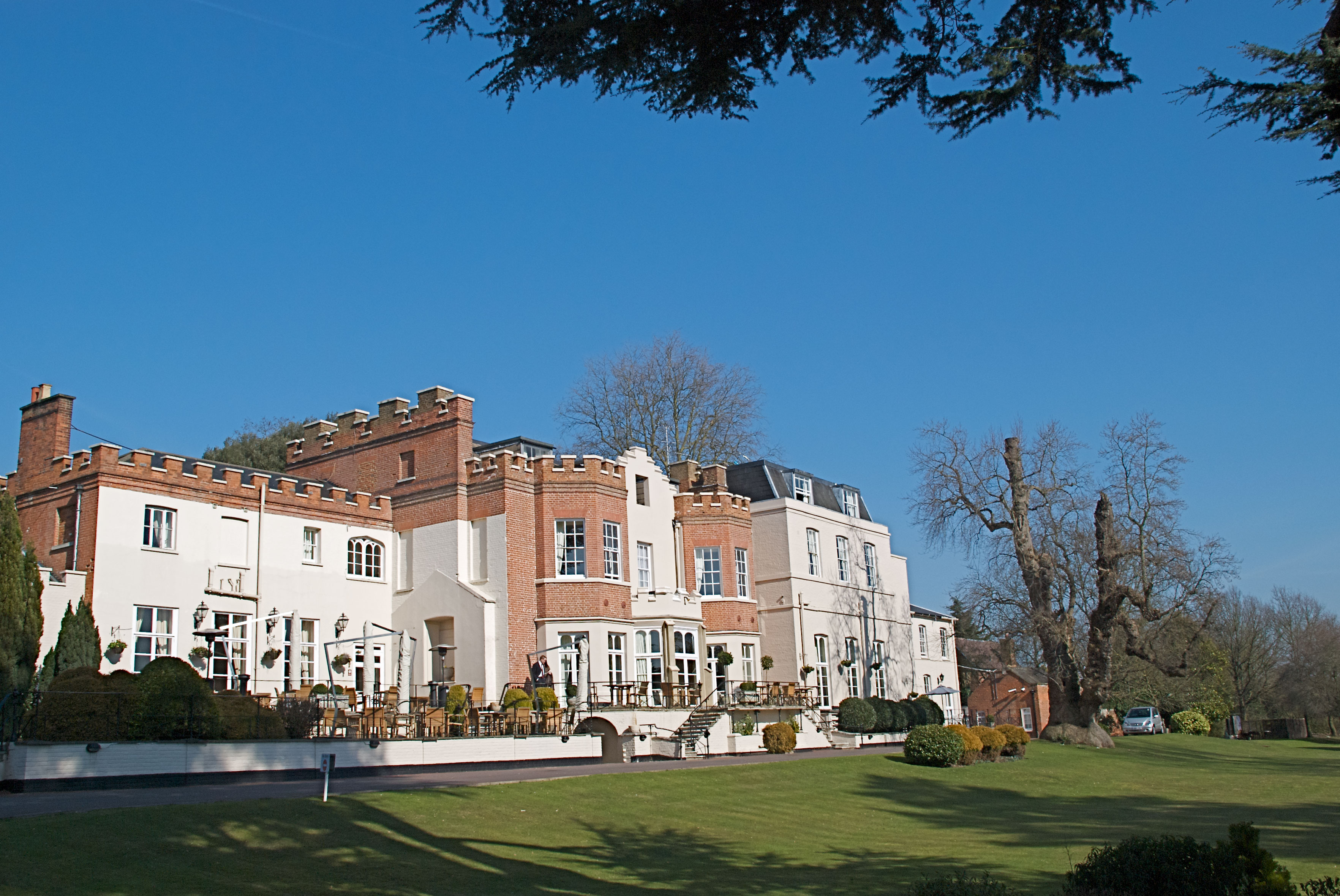
[ The first part of the following article is an extract from Gardening Tours by J.C. Loudon 1831-1842. Ed ] The house is situated half-way down the same high bank on which is placed Taplow Court, Park Place, Cliveden, Hedsor, and a number of other fine places, commencing at Richmond, and extending, on the same side of the river, to near Reading, where the banks become level on both sides. The house is here, very properly, entered from behind; and the view from the principal rooms commands the Thames and Windsor Castle. The grounds are not very extensive; but the lawn slopes most beautifully, and it is judiciously varied by choice trees and shrubs, and beds of flowers, the latter of the rarest and most beautiful kinds, assiduously and successfully cultivated, and kept in the most exquisite order by the gardener, Mr. Springall, who has been in that capacity here for thirty years, and has planted nearly every tree, and laid out every bed. The first view of the lawn front of the house, bosomed as it is in verandas covered with creepers and in banks of flowers, as seen from a dark walk near the lodge, through which strangers are introduced, operates like enchantment.. The first wing of the house is only one story high, and contains a suite of rooms, including a library, shaded by a skeleton veranda. By this term we mean a veranda that, instead of a close roof, has merely the wall plate, and a slight rafter from the top of each prop. These members are entirely covered with vegetation in great luxuriance, and chiefly by the Virginian creeper. The railing of a balcony in front of the dining-room is similarly covered, as is the veranda over it. The central part of the basement of the house may be described as embosomed in rockwork and flowers in pots and vases. On one end of the house is a Beurre d'Aremberg pear tree, 30 ft. high, covered with fruit. Turning round before the steps which descend from the drawing-room to the lawn, the latter is varied by beds of flowers which lose themselves among trees, shrubs, and glades in every direction, but so far below the eye, that, when looking at them, the distant scenery is not taken into the landscape. Raising the eye, we catch the Thames and Windsor Castle between the tops of the trees. The walk proceeds in a winding direction till it reaches a straight walk shaded by elms, the simplicity of which contrasts finely with the variety and intricacy of the other walks. Among the trees not planted by Mr. Springall, may be noticed a magnificent plane, 100 ft. high, with branches extending far on every side, and sweeping the ground; a tulip tree, 70 ft. high, and some noble elms. We were particularly struck with the vigorous growth of every description of plant introduced in the flower-beds; and we were informed by Mr. Springall of the cause; viz., that he takes out the soil every year to the depth of 2 ft. or 3 ft., and renews it entirely. He does not introduce a single bed, or even a single plant, however common may be the kind, without this precaution. On observing the flower-stems and remaining flowers of Gladiolus byzantinus very strong, Mr. Springall stated that he never puts dung in his compost for these plants, but only uses yellow loam with a little sand. The different dwarf blue-flowered lobelias, such as L. unidentata, bellidifolia, erinoides, &c., grow here so much larger than we have seen them any where else, that they appeared like distinct varieties. The same may be said of the different verbenas and of most of the other usual lawn plants. The masses of blossom shown by single pelargoniums were remarkably fine; some of them were 3 ft. in diameter at the base, and 6 ft. high, forming a complete cone of scarlet flowers. These plants continue in bloom all the summer, a particular variety being used for that purpose, which is obtained in the following ingenious manner:- It is well known to gardeners that variegated-leaved pelargoniums flower more freely, and for a greater length of time, than any of the varieties which are not variegated; but then these variegated plants never grow large, or produce strong wood and vigorous leaves. To obtain strong wood and luxuriant foliage, as well as a continuance of bloom all the season, Mr. Springall chose a cutting from a variegated plant which had run, or returned to its original green; and from this cutting he propagated the plants which he trains as cones. We may observe, that here, as at Dropmore, the walks were brimful of gravel, and the grass edgings clipped, and not pared, which, as we have often before said, is one of the greatest beauties in the details of walks, though we cannot get it attended to half so much as we could wish. Mr. Springall is enthusiastically devoted to his profession, and is in his garden, as he informed us, from four o'clock in the morning till it is dark at night. His master never interferes with his management, and this will always be found to be the case, when the garden is so well conducted as it is here. Mr. Springall lives in a pretty thatched cottage by the road side, with an octagon front, and a veranda ornamented by creepers; he has also a very neat flower-garden in front. Opposite the entrance to Taplow House is another handsome cottage, with a beautiful flower-garden in front, evidently under the superintending care of Mr. Springall; so that the general impression, both on entering and leaving the place, is that of comfort, neatness, and fine flowers... ... And a neighbour's. viewpoint We first came to Taplow 43 years ago and lived next door to Mr Page. He had been an apprentice gardener at 14 and subsequently became head gardener to Mrs Skimmings who was the last owner of Taplow House, when it was a private residence. Unfortunately she had no heirs because the sons of the house, had like so many others, died in the Great War, but Mr Page told us that she had planned to pull the two wings of the house down to make it smaller and more manageable but died before she could put this into effect. She had decreed in her will that Mr and Mrs Page should live in the stable block at a peppercorn rent for life. He used to garden in the old fashioned way by raising all his bedding plants from seeds or cuttings in his greenhouses and planting them out twice a year. The vegetables in their plot marched productively in straight lines and ne'er a weed dared show its face. I learnt a great deal about plants from old Mr Page and also about the house and grounds as he had known them. We live in one of the many old kitchen gardens which used to grow peaches on the south facing wall, while the garden itself produced potatoes. The legacy of Mr Page's reign is wonderful topsoil. On our north facing wall you can still see part of an old fireplace and various whitewashed sections, which were the bachelor gardeners' bothys where they lived. It could have been neither warm nor comfortable for them. Our forecourt used to be the farmyard, the wing of our house the milking parlour, while the pigsties were along one side of our forecourt. Jersey cows used to graze on the part of the hill which is now Saxon Gardens and where the houses facing Berry Hill stand. When we arrived on the scene Taplow House was a depressing old people's home in a very dilapidated state. Occasionally one of the old folk would 'escape' and be given a cup of coffee by another neighbour before being brought back again. The next owners of Taplow House were a pilot and his wife who tried to run it as a hotel. He was forever up ladders trying vainly to maintain the building, and literally stop the rot, but the project was too much for them, especially as the wife was prone to drink the meagre profits. They planted an orchard on what is now the front lawn, which the next owners dug up and put back to grass. The house then continued its career as a hotel passing from owner to the next, each one spending large sums of money upon it and then selling it on. We have been delighted with the rescuing of and improvements to the old building which has shaken off its forlorn sad rundown air and is once more cared for and a place of comfort and luxury, so much so that we chose to hold our daughter's wedding there. Eva Lipman