
Archived Page
This page is no longer maintained.
For up-to-date information please see the
new website
The John Noble House
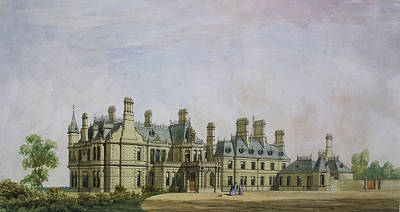 Miv Wayland-Smith found two watercoulour paintings of an unbuilt Taplow house for sale on Sarah Colgrave's fine-art website. The story behind them is fascinating
John Noble was the heir to a highly successful paint and varnish manufacturer. In addition to property in London he owned land and several houses to the north-east of Maidenhead and in and around the village of Taplow in Buckinghamshire, including an estate at Berry Hill. In the 1850s he moved his family into the Georgian house at Berry Hill, once the residence of the Earl of Kilmorey, and partly designed by Sir John Soane. Between 1856 and 1860 Noble employed Robert Marnock to design gardens and a small park with extensive artificial rockwork and a waterfall by James Pulham. By the late 1860s Noble was obviously finding Berry Hill to be rather too confining for his large Victorian family of seven children and numerous domestic staff and considered building a new, larger and more impressive house. This pair of architect’s perspective watercolours of a proposed Rothschild-style mansion for Berry Hill date from this period. It seems that this proposed house was never realized as in 1870 Noble purchased Park Place, overlooking the Thames to the south of Henley on Thames. The house at Park Place was in a poor state and he employed Thomas Cundy to build a large and impressive house in the French Renaissance style, which still stands. (Park Place was sold for £42million in 2007, making it then the most expensive house sold in the Britain.)
Miv Wayland-Smith found two watercoulour paintings of an unbuilt Taplow house for sale on Sarah Colgrave's fine-art website. The story behind them is fascinating
John Noble was the heir to a highly successful paint and varnish manufacturer. In addition to property in London he owned land and several houses to the north-east of Maidenhead and in and around the village of Taplow in Buckinghamshire, including an estate at Berry Hill. In the 1850s he moved his family into the Georgian house at Berry Hill, once the residence of the Earl of Kilmorey, and partly designed by Sir John Soane. Between 1856 and 1860 Noble employed Robert Marnock to design gardens and a small park with extensive artificial rockwork and a waterfall by James Pulham. By the late 1860s Noble was obviously finding Berry Hill to be rather too confining for his large Victorian family of seven children and numerous domestic staff and considered building a new, larger and more impressive house. This pair of architect’s perspective watercolours of a proposed Rothschild-style mansion for Berry Hill date from this period. It seems that this proposed house was never realized as in 1870 Noble purchased Park Place, overlooking the Thames to the south of Henley on Thames. The house at Park Place was in a poor state and he employed Thomas Cundy to build a large and impressive house in the French Renaissance style, which still stands. (Park Place was sold for £42million in 2007, making it then the most expensive house sold in the Britain.)
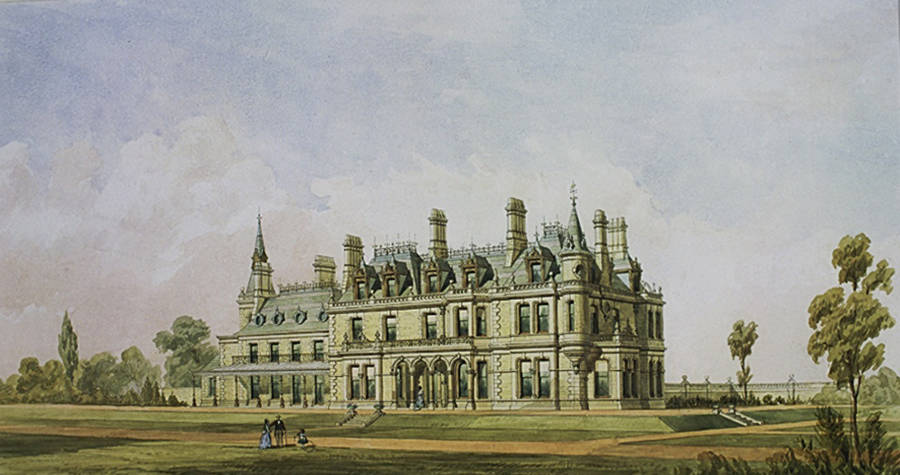 Percy Noble, John Noble’s youngest son, returned to live in Taplow. He set up home at Taplow Priory, another of the Noble properties in the area, where he also developed extensive grounds and gardens. The original Soane house at Berry Hill left the Noble family. It became a hotel and country club in the 1950s and was sadly destroyed by fire in the 1970s. A modern block of flats now stands on the original site.
Miv Wayland-Smith
Percy Noble, John Noble’s youngest son, returned to live in Taplow. He set up home at Taplow Priory, another of the Noble properties in the area, where he also developed extensive grounds and gardens. The original Soane house at Berry Hill left the Noble family. It became a hotel and country club in the 1950s and was sadly destroyed by fire in the 1970s. A modern block of flats now stands on the original site.
Miv Wayland-Smith