Archived Page
This page is no longer maintained.
For up-to-date information please see the
new website
Taplow People: Peter Lane
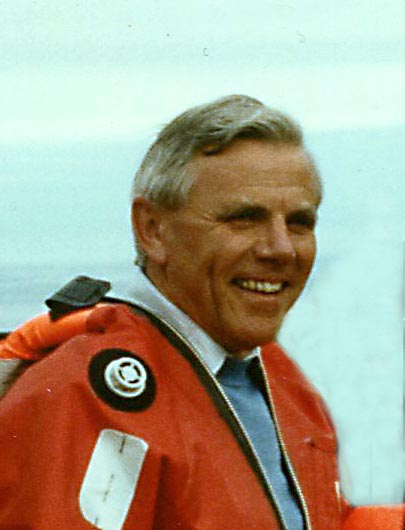
A while ago we changed the name of your Society to more properly reflect the focus of our community activity. The previous concentration on ‘preservation’ tended to bias the theme of the Newsletter towards the geography, buildings, appearances and the local countryside in our parish but we, who actually live here, tended to get a bit sidelined. When you think of it, our small community seems to have more than a normal share of interesting people living in it and your committee felt it would be a worthwhile commencement of our next half-century to introduce some of these people to you. However, we will not be confining ourselves to Taplow’s 'movers and shakers' because every one of us has an interesting, often fascinating, story to tell about some aspect of our life, which we can all gain a little from hearing about. The first (reluctant) volunteer is Dr Peter Lane who had a major role in a great British achievement. Ed.The Development of the Magnus Oilfield
 In 1955 as a young petroleum engineer in Kirkuk, North Iraq, I little thought that 20 years later I would be back in the UK, leading a team to develop the Magnus Oilfield 135 miles North-East of Shetland. In the intervening years my career took me to the US and several of the Gulf States when it came full circle back to Kirkuk and finally Basrah in Southern Iraq. It was from there that we, as a family, were thrown out by Saddam Hussein to return to the UK late in 1975.
When I originally went to Iraq the prospect of oil or gas being discovered in the North Sea was not contemplated. Now, on my return, the UK was enjoying gas from the Southern North Sea, and the mighty Forties Field, 110 miles east of Aberdeen in 300 feet of water, was supplying 20% of the UK oil requirements.
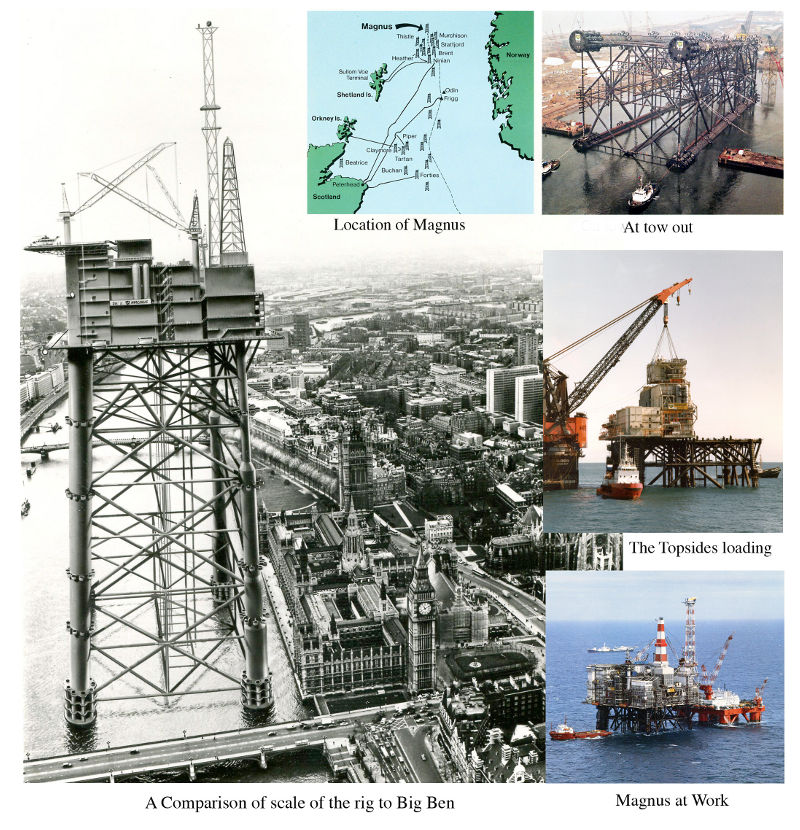
Exploration activity had moved north and 135 miles North-East of Shetland the Magnus Oilfield was discovered in 1974. St Magnus is the patron saint of Kirkwall in the Orkneys. This oil find was the most northerly yet discovered and in a very hostile environment: 620 feet of water with the possibilities of storms with 100-foot waves and winds of 120 mph. The discovery took two years to evaluate and proved to be a long thin reservoir, located 10,000 feet below the seabed. A budget of £1.3billion was approved for the development with a target on-stream of mid-1983. The plan required some 15 wells, drilled at various angles from the central platform, together with several sub-sea wells also controlled from the platform. The produced oil, after its separation from its associated gas and water, was to be pumped via a 24-inch buried line to Sullom Voe Terminal in the Shetlands.
The platform to be used was designed with four legs, each some 34 feet in diameter, to be pinned to the seabed by 34 massive steel piles, each 7 feet in diameter, 320 feet long and weighing 330 tons. The platform was constructed on its side at Nigg Bay, Moray Firth, in a huge dry dock. The weight at tow-out was some 30,000 tons, with a capability of supporting a topsides weight of some 35,000 tons. The topsides, i.e. the drilling rig's oilfield plant equipment accommodation for 200 staff and a large helideck, consisted of 17 modules or steel boxes, each weighing up to 2,000 tons. This weight was the maximum lift of the world’s largest floating crane at that time. The helideck had to be capable of accommodating two Chinook helicopters (specially imported for civilian use). Why space for two? - because, if one helicopter was parked and a second one flying in encountered trouble, it had to land immediately, thus if the helideck was not large enough, the parked machine had to be pushed over the side – an expensive option!
The modules were constructed at yards on the Tay, Tyne, Tees and Moray Firth and in Holland. On 1st April 1982, the onshore construction was substantially complete and float-out of the platform on its side from Nigg, with a 350-mile tow to Magnus, got under way in predicted calm seas. However, the weather was not kind. Once on location, the up-ending to the vertical commenced, but unfortunately disaster struck. Several anchoring piles slipped free and pinned the platform to the sea bed at an alarming angle – a heart-stopping moment. Here was the world’s largest and most costly steel structure, costing £200 million, in serious danger of sinking! The world’s press was represented and watching but the Falklands war was raging, and press coverage was limited. We waited on tenterhooks for the results of computer simulation studies to confirm whether it was safe to pull the platform free from the slipped piles pinning it to the seabed. This simulation confirmed it should be safe so the decision was made and the pull-off was successfully achieved. On 4th April 1982 the platform settled vertically on the seabed in the assigned position to great relief all round.
Once the platform was pinned to the seabed the barges carrying the topside modules began to arrive, and lift-on with the floating crane commenced, rather like stacking bricks. The next task was hook-up, a monumental task of joining all the plant and equipment to make a working oilfield. This required a workforce of 1,200, working 12 hours on, 12 hours off, for two weeks followed by one week ashore. A logistical nightmare – hence the need for the two Chinook helicopters each carrying 50 workers from our base in Aberdeen. In addition, a specially designed 'flotel' was constructed in Japan to house some 1,000 workers. A further vessel, a 2,000-ton safety boat, was built at Lowestoft, and was on station at all times, equipped with a fire-fighting system, workshops and emergency accommodation.
The hook-up stage was substantially complete by Easter 1983, and commissioning commenced with the initial oil flowing from the sub-sea wells and thence to the Sullom Voe Terminal on 14th August 1983.
By this time I had been promoted to be CEO of BP Exploration and Production and we were enjoying a family holiday in Rhodes when I received a call from Magnus saying, 'We are on stream.' This was an exciting but demanding project, particularly due to the water depth and harsh environmental conditions. Magnus is still on stream.
All this happened 25 years ago. The industry has moved on and, for example, in the Gulf of Mexico, oil exploration and developments are taking place in waters one and three-quarter miles deep, and with horizontal drilling extending to some 7 miles. The availability of huge floating cranes capable of lifting 30,000 tons has reduced offshore working to allow the hook-up phase to be undertaken onshore, thus saving time and costs.
I was fortunate to be part of the Magnus Team, and in 1984 the Company was awarded The Queen’s Award for Technological Achievement. The citation hangs in my study.
On retiring in 1985, I was awarded an OBE for services to the oil industry both in the Middle East and the North Sea.
Peter Lane
In 1955 as a young petroleum engineer in Kirkuk, North Iraq, I little thought that 20 years later I would be back in the UK, leading a team to develop the Magnus Oilfield 135 miles North-East of Shetland. In the intervening years my career took me to the US and several of the Gulf States when it came full circle back to Kirkuk and finally Basrah in Southern Iraq. It was from there that we, as a family, were thrown out by Saddam Hussein to return to the UK late in 1975.
When I originally went to Iraq the prospect of oil or gas being discovered in the North Sea was not contemplated. Now, on my return, the UK was enjoying gas from the Southern North Sea, and the mighty Forties Field, 110 miles east of Aberdeen in 300 feet of water, was supplying 20% of the UK oil requirements.
Exploration activity had moved north and 135 miles North-East of Shetland the Magnus Oilfield was discovered in 1974. St Magnus is the patron saint of Kirkwall in the Orkneys. This oil find was the most northerly yet discovered and in a very hostile environment: 620 feet of water with the possibilities of storms with 100-foot waves and winds of 120 mph. The discovery took two years to evaluate and proved to be a long thin reservoir, located 10,000 feet below the seabed. A budget of £1.3billion was approved for the development with a target on-stream of mid-1983. The plan required some 15 wells, drilled at various angles from the central platform, together with several sub-sea wells also controlled from the platform. The produced oil, after its separation from its associated gas and water, was to be pumped via a 24-inch buried line to Sullom Voe Terminal in the Shetlands.
The platform to be used was designed with four legs, each some 34 feet in diameter, to be pinned to the seabed by 34 massive steel piles, each 7 feet in diameter, 320 feet long and weighing 330 tons. The platform was constructed on its side at Nigg Bay, Moray Firth, in a huge dry dock. The weight at tow-out was some 30,000 tons, with a capability of supporting a topsides weight of some 35,000 tons. The topsides, i.e. the drilling rig's oilfield plant equipment accommodation for 200 staff and a large helideck, consisted of 17 modules or steel boxes, each weighing up to 2,000 tons. This weight was the maximum lift of the world’s largest floating crane at that time. The helideck had to be capable of accommodating two Chinook helicopters (specially imported for civilian use). Why space for two? - because, if one helicopter was parked and a second one flying in encountered trouble, it had to land immediately, thus if the helideck was not large enough, the parked machine had to be pushed over the side – an expensive option!
The modules were constructed at yards on the Tay, Tyne, Tees and Moray Firth and in Holland. On 1st April 1982, the onshore construction was substantially complete and float-out of the platform on its side from Nigg, with a 350-mile tow to Magnus, got under way in predicted calm seas. However, the weather was not kind. Once on location, the up-ending to the vertical commenced, but unfortunately disaster struck. Several anchoring piles slipped free and pinned the platform to the sea bed at an alarming angle – a heart-stopping moment. Here was the world’s largest and most costly steel structure, costing £200 million, in serious danger of sinking! The world’s press was represented and watching but the Falklands war was raging, and press coverage was limited. We waited on tenterhooks for the results of computer simulation studies to confirm whether it was safe to pull the platform free from the slipped piles pinning it to the seabed. This simulation confirmed it should be safe so the decision was made and the pull-off was successfully achieved. On 4th April 1982 the platform settled vertically on the seabed in the assigned position to great relief all round.
Once the platform was pinned to the seabed the barges carrying the topside modules began to arrive, and lift-on with the floating crane commenced, rather like stacking bricks. The next task was hook-up, a monumental task of joining all the plant and equipment to make a working oilfield. This required a workforce of 1,200, working 12 hours on, 12 hours off, for two weeks followed by one week ashore. A logistical nightmare – hence the need for the two Chinook helicopters each carrying 50 workers from our base in Aberdeen. In addition, a specially designed 'flotel' was constructed in Japan to house some 1,000 workers. A further vessel, a 2,000-ton safety boat, was built at Lowestoft, and was on station at all times, equipped with a fire-fighting system, workshops and emergency accommodation.
The hook-up stage was substantially complete by Easter 1983, and commissioning commenced with the initial oil flowing from the sub-sea wells and thence to the Sullom Voe Terminal on 14th August 1983.
By this time I had been promoted to be CEO of BP Exploration and Production and we were enjoying a family holiday in Rhodes when I received a call from Magnus saying, 'We are on stream.' This was an exciting but demanding project, particularly due to the water depth and harsh environmental conditions. Magnus is still on stream.
All this happened 25 years ago. The industry has moved on and, for example, in the Gulf of Mexico, oil exploration and developments are taking place in waters one and three-quarter miles deep, and with horizontal drilling extending to some 7 miles. The availability of huge floating cranes capable of lifting 30,000 tons has reduced offshore working to allow the hook-up phase to be undertaken onshore, thus saving time and costs.
I was fortunate to be part of the Magnus Team, and in 1984 the Company was awarded The Queen’s Award for Technological Achievement. The citation hangs in my study.
On retiring in 1985, I was awarded an OBE for services to the oil industry both in the Middle East and the North Sea.
Peter Lane