Archived Page
This page is no longer maintained.
For up-to-date information please see the
new website
Taplow Lancers
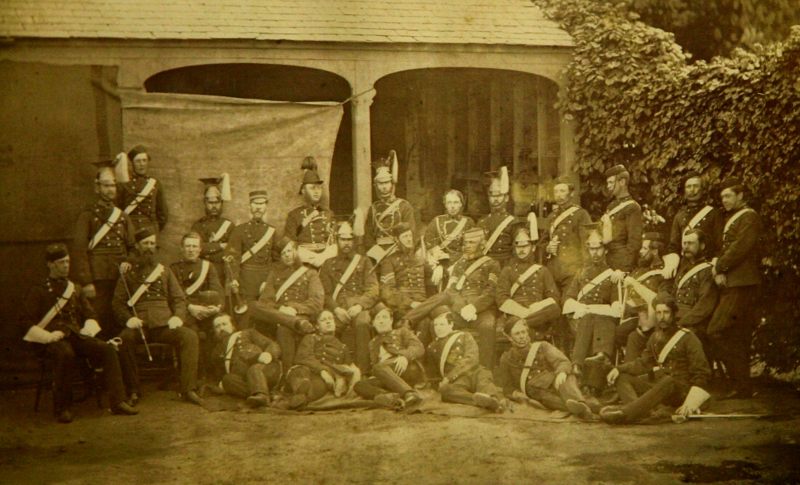
This is an adaptation by Laird Mackay from his exhibit Military and Aviation at the Taplow Heritage Day. 1794 Units of mounted volunteers known as yeomanry were formed throughout the country. Six troops of Bucks Yeomanry were originally raised in May 1794 but by 1803 there were sufficient yeoman to form three regiments, the lst of Southern Cavalry including a troop at Taplow. 1830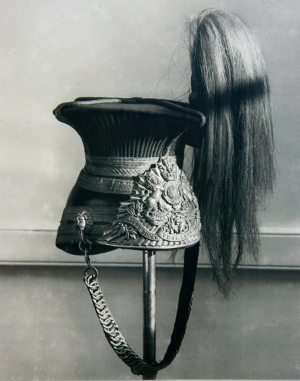 The Yeomanry was reduced and the lst Regiment was disbanded but in December 1830 Buckinghamshire, like other southern counties, saw an outbreak of widespread machine breaking during the so-called Swing Riots. As a result, Viscount Kirkwall, later Earl of Orkney, decided to raise a new yeomanry troop at Taplow, which was authorised on 27 December 1830. Almost immediately the new troop was called out on duty at Princes Risborough, helping to protect the King’s Commission sitting at Aylesbury to try those arrested during the riots.
1838
With the dangers of domestic unrest seemingly subsiding, the War Office decided once more to cease funding the troop in March 1838 but the troop decided to continue to service without any government pay or allowances. The troop offered its services in anticipation of Chartist disturbances at Slough in 1848 but was not needed. The annual training – usually just eight days – was held at various locations including Beaconsfield, Marlow, Burnham and Slough. In May 1863 the Earl of Orkney resigned his command and was succeeded as Captain Commandant by Nathaniel Grace Lambert of Denham Court, who was later Liberal MP for Buckinghamshire from 1868 to 1880. Under his command, the annual training was switched to Windsor. From 1867 onwards, Lambert’s second in command was Orkney’s son, Lieutenant the Hon. Alexander Fitzmaurice, and the Cornet (Second Lieutenant) was Roger Eykyn, a stockbroker who served as Liberal MP for Windsor from 1866 to 1874. The most notable event at this time was the troop’s participation in the great volunteer review at Windsor in July 1869.
1863
For much of its existence the troop’s uniform was that of a light dragoon regiment but at about the time of Orkney’s resignation in 1863, the uniform was changed to that of a lancer regiment modelled on that of the 12th Lancers. The official title remained the South Buckinghamshire Yeomanry Cavalry but the unofficial title became the Taplow Lancers and Lambert himself began signing orders as commander of the Taplow Troop (Lancers) in 1869.
1867
Increasingly, there were problems in finding sufficient recruits within the county and in any case the War Office decided in 1871 to disband independent yeomanry units with less than four troops. In the event, it was decided to accept the inevitable and the Taplow Lancers ceased to exist in June 1871.
Just five Taplow men were serving in the unit at this time, Sergeant W Rance (a butcher), Corporal R Cleare (a victualler), and Troopers J Cleare (presumably the son of the former), H Davis, and C Cross (a farmer’s son).
Laird McKay
The Yeomanry was reduced and the lst Regiment was disbanded but in December 1830 Buckinghamshire, like other southern counties, saw an outbreak of widespread machine breaking during the so-called Swing Riots. As a result, Viscount Kirkwall, later Earl of Orkney, decided to raise a new yeomanry troop at Taplow, which was authorised on 27 December 1830. Almost immediately the new troop was called out on duty at Princes Risborough, helping to protect the King’s Commission sitting at Aylesbury to try those arrested during the riots.
1838
With the dangers of domestic unrest seemingly subsiding, the War Office decided once more to cease funding the troop in March 1838 but the troop decided to continue to service without any government pay or allowances. The troop offered its services in anticipation of Chartist disturbances at Slough in 1848 but was not needed. The annual training – usually just eight days – was held at various locations including Beaconsfield, Marlow, Burnham and Slough. In May 1863 the Earl of Orkney resigned his command and was succeeded as Captain Commandant by Nathaniel Grace Lambert of Denham Court, who was later Liberal MP for Buckinghamshire from 1868 to 1880. Under his command, the annual training was switched to Windsor. From 1867 onwards, Lambert’s second in command was Orkney’s son, Lieutenant the Hon. Alexander Fitzmaurice, and the Cornet (Second Lieutenant) was Roger Eykyn, a stockbroker who served as Liberal MP for Windsor from 1866 to 1874. The most notable event at this time was the troop’s participation in the great volunteer review at Windsor in July 1869.
1863
For much of its existence the troop’s uniform was that of a light dragoon regiment but at about the time of Orkney’s resignation in 1863, the uniform was changed to that of a lancer regiment modelled on that of the 12th Lancers. The official title remained the South Buckinghamshire Yeomanry Cavalry but the unofficial title became the Taplow Lancers and Lambert himself began signing orders as commander of the Taplow Troop (Lancers) in 1869.
1867
Increasingly, there were problems in finding sufficient recruits within the county and in any case the War Office decided in 1871 to disband independent yeomanry units with less than four troops. In the event, it was decided to accept the inevitable and the Taplow Lancers ceased to exist in June 1871.
Just five Taplow men were serving in the unit at this time, Sergeant W Rance (a butcher), Corporal R Cleare (a victualler), and Troopers J Cleare (presumably the son of the former), H Davis, and C Cross (a farmer’s son).
Laird McKay