Archived Page
This page is no longer maintained.
For up-to-date information please see the
new website
Why Buffins?
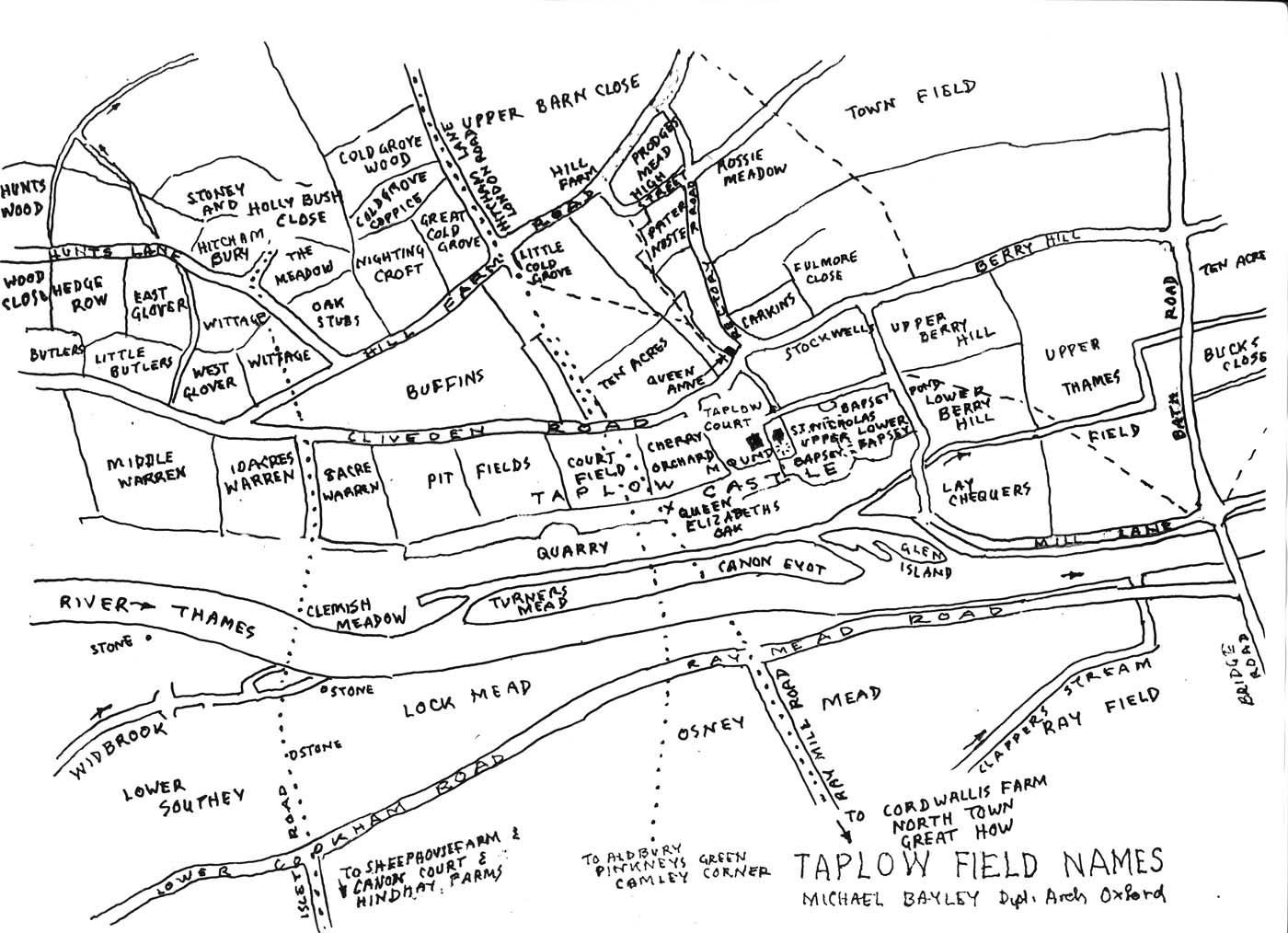
Part 1 You will not find an explanation of this name in any book – you must go to the oral history of the area that preserved the local legend of St Berinus, which itself never came out of any really ancient book. If you remember the story, St Berinus baptised all the Saxons in Taplow Castle in Bapsey Pond, and the first Christian church was built beside Taplow Court within the castle defence. From this original local legend we see that the good saint didn’t baptise the local British people of Taplow who adhered to the old pagan religion, so that it became accepted as the centre of local witchcraft - and today still attracts neo-witchcraft groups. My great aunts used the services of the Taplow Wise Women who taught pillow lace-making and could cure most diseases, and perhaps that is why they found a bowl made from a human skull in Bapsey Pond when it was cleaned out in the 1960s, and the witches curse on the Desborough family for enclosing the spring that fed Bapsey Pond did come true. The British language survived as a second semi-secret language of the land and the river until it was killed off by an alliance of the railways, Victorian education and snobbery, in the mid-nineteenth century. So the place and field names of Taplow are corruptions of this Lowland British language, and the local history of the district – from the Neolithic to the present day - was passed on orally among the farming yeomanry. Local farmers claim to have come from good yeoman stock – their ancestor was an Ior-man, or ‘petty lord’, the lowest rank of the nobility or squirearchy. Locally it was held that Hitchambury was the original settlement in the area. The name derives from Uchel am burrow, meaning ‘The earthworks (banks and ditches) of the highest cultivated land and its cultivators’. An adjacent field south of Hitchambury is called The Meadow. It is a meadow, but to the Britons it was Ty– med da, that is ‘The house of the field of the cattle’. West of this where the entrance to Hitchambury and Hunts Wood branches off Hill Farm Road is a small field called Oak Stubbs, which sits on the crest of the hill. It is unlikely to have been a felled oak wood from its size and position, so the name was probably Ugh-stum, or ‘The high bend’. Opposite this road junction lay the large field called Buffins, once called Bugh-fan meaning ‘The place of the cows’. On the northeast corner of Hitcham Lane is Great Colgrove, anciently gre-ty-kole-crow fa, meaning ‘The place of the young bull’s hovel’. This makes it quite convenient for the Buffins cows! Nearby are the wood and coppiced woodlands that produced good browsing for the young bull. One must remember that cattle are naturally browsing animals of the woodland or marsh – not naturally grazing animals. Diagonally opposite across the road and on the edge of Buffins is Little Coldgrove, or Laity kole crow fa, meaning ‘The dairy by the place of the young bull's hovel’. The corner of Buffins adjacent to Taplow Court is called Ten Acres. In fact it is only eight and a bit acres, but don’t suggest to me that primitive peasants weren’t good at measuring land accurately: my market-gardening brother-in-law found that illiterate gypsies who were paid by the acre for pea-picking could accurately estimate an area instantly – a task which would take a modern surveyor hours to measure! This ‘Ten Acres’ was known as Tir-ner-argae, which meant ‘The enclosure of the lord of the manor’, and it is easy to see how this converts to the modern version. My great aunt first took me to Taplow in the 1920s. She and her contemporaries still referred to Hitcham Lane by its old name of London Road. It is part of the medieval road that linked most of the South Bucks villages with ancient churches in Taplow, Hitcham, Burnham, Farnham, Wexham, Iver and so on. If you continue the line of Hitcham Lane straight across Buffins you arrive at Court Field, where the archaeologists discovered the entrance to the Bronze Age Taplow Castle. In the middle of the ride on the west side of this field is the modern incarnation of Queen Elizabeth Oak. As the previous one dies, a new one has been planted – for millennia - but there is no record of the Tudor Queen Elizabeth coming here or planting any tree. It marks the course of London Road and Taplow on the escarpment from the river and was called in ancient times Quidden un alaw ys beth, that is ‘The oak of the Holy One of the lily place beneath the tomb’. Taplow’s marshy areas were famous for the profusion of lilies (water irises) even in Victorian times, and the tomb is of course the mound that gives Taplow its name Tir pel ior, that is ‘The tumulus of the distant lord’. We now know from archaeology what the local Britons knew from history passed by word of mouth, that the man in the tumulus was a Saxon Lord from Kent! Over the escarpment was Maidenhead’s first bridge, over which there were two battles in the 14th century. The road continued on the Berkshire bank as Ray Mill Road to North Town and Great How; the latter was still a coaching stop on the road linking London to Bath or Oxford in the 17th and 18th centuries. This old Bath Road ran between Court Field and Cherry Orchard inside Taplow Castle. No one in their senses plants a cherry orchard alongside a busy road and the windy top of an escarpment is not horticulturally sensible. This was where the Lord of the Manor distributed largess, on Taplow Castle's parade ground or town square, between the Lord's Court or Caer ty (Fort House) and his and the villagers' dwellings. It was the place of the Chwarae-or-chy-da, or Buffins. Michael Bayley (For those of you unfamiliar with Michael, he is a retired architect with an encyclopaedic knowledge of the Taplow and its environs who lives in Maidenhead. His contributions to your newsletter over the years have been an invaluable source of material for your ex-editor. This is the first article of a two-parter on Buffins and its background. Fred Russell.)