
Archived Page
This page is no longer maintained.
For up-to-date information please see the
new website
Old Cottage - The Oldest House in Taplow
When I was first asked to write a history of Old Cottage I was, for a long time, reluctant to undertake the task, as researching the history of a 400-year-old property presents many difficulties - not least the fact that no deeds as such are available before 1825. According to the Victoria County History, the Taplow Manor was bestowed on Charles Harbert, by whom it was sold in 1635 to Thomas Hamson, whose son, Dennis, held it until some time about 1700, when he sold it to George, Earl of Orkney. An exceedingly long, faded, hand-written document of that date records the sale of land containing a number of cottages or 'messuages' from Taplow Court Estate. The Deed mentions a number of prestigious names, the main one being that of the Earl of Orkney who in 1852 'alienated' (transferred) it to Charles Pascoe Grenfell whose grandson was created Lord Desborough in 1905 and remained Lord of the Manor until its sale to the present occupants some years ago. The original church of St Nicholas (spelt thus in old documents) stood on the site of the Mound or Low near the present Taplow Court. The Mound contained the remains of an important Saxon king called Tappa - thus Taplow. This old church fell into disrepair and was replaced by a Georgian-style rectangular church, which opened in 1828 on the site at the bottom of the High Street where the present church stands today, and the present building (now spelt without the 'h') was consecrated on 6 December, St Nicholas' Day, 1912.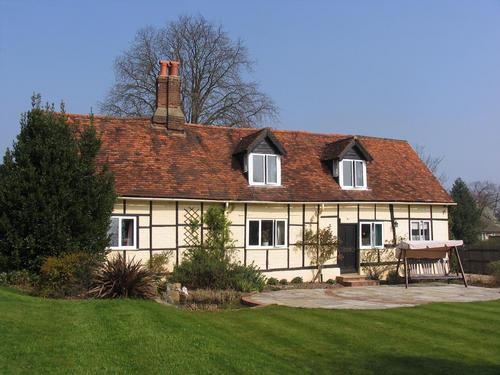 There is no way of knowing accurately the history of Old Cottage but, bearing in mind that there would have been only a few other properties here at the time - namely the two nearby cottages now known as The Porches and three further to the east known as Neighbours, Elmbank and Losuce, which some historians suggest were once six tiny cottages and are now two houses, the rest being open fields right down to the river - it is highly likely that Old Cottage was once a small farmhouse, most probably thatched, and the other cottages part of a smallholding. These properties have been considerably altered and extended over the years with the addition of the staircases, dormer windows and, most recently of all, the modern facilities necessary to our lives today.
Over its 400 years, Old Cottage has had many owners too numerous to mention so I will recount only its more recent history. In 1871, Taplow Wesleyans preached out-of-doors, possibly by the large chestnut tree beside my garage. In 1872, they purchased a piece of land at what is now the southern boundary of my garden for the construction of a wooden chapel. It is described as being bounded to the east by the High Road leading to the church and to the south by the National School. I have two or three of the original foundation stones inscribed with initials and dates in my garden today. The chapel fell into disuse when the new Methodist church was built in Lent Rise and was eventually pulled down and the land once more became part of the curtilage of Old Cottage. The old school buildings were still in existence when I bought Old Cottage in 1967 though it had stood empty since the new school opened in 1964. (I had to make certain of the plans for its replacement in case of the possibility of high-rise flats overlooking me. Fortunately the site was wanted for a car park.)
When I bought Old Cottage in 1967 it was in an appalling state of disrepair. The only electric light in the living room came from a two-strand wire coming from a two-pin plug by the door and strung along the wall to a single unshaded bulb hanging from a hook over the fireplace. (This was immediately condemned by the authorities.) The kitchen was in a timber lean-to from which one could see daylight through the slats in the roof. It contained an old square sink with a water pump and the most ancient rusty gas cooker I had ever seen. I added the modern extension you see from the High Street today to provide a decent kitchen with a third, single bedroom above. Remember that when the cottage was first built there were no roads - only open fields down to the river - and that will explain why my front door is on the south side of the building and not facing the road of today. Total re-wiring was necessary and in order to install central heating it was essential to dry-line the walls to retain the heat and stop the old, original bricks from crumbling. The attention of damp-proofing and woodworm experts was urgently required before any decorating or furnishing could take place. Other improvements such as a new brick-built garage, new fencing and the steps up from the High Street were added over time as funds permitted. When I first lived here my only entry was from the side gate on the footpath, which was not only very muddy in bad weather but extremely dark and quite scary to use late at night. The only light on that corner continues to be the one from the lamppost at my gate and by my garage. None has ever been provided here by the local authority!
In 1920, Sir John and Lady Beatrice Pole-Carew bought Knoll House, renamed it Maryfield and added a servants' wing to the north-east side. They also acquired the Coach House - now known as Maryfield Cottage - and Old Cottage. Maryfield Cottage still had the two two-storey coach-house doors in the east side of the house when I first came here. This part was later remodelled to form the charming upper drawing room which now exists there. During the Second World War, Lady Beatrice (by then a widow) moved into Old Cottage and lived there until she died in 1953. As Maryfield and the Coach House had now been sold, her daughter, Miss Mary Pole-Carew, moved into Old Cottage but retained a piece of land to the south of the Coach House for a garage for her car and also a small piece of land on the other side of the driveway leading up to Maryfield because she hoped to be able to drive her car across to what is now the side gate of Old Cottage. She made several attempts to obtain planning permission to do this but these were always refused as she would have had to cross a Bucks County Council designated footpath and permission to do that would never be given. This explains the anomaly of the positioning of my garage today.
There is no way of knowing accurately the history of Old Cottage but, bearing in mind that there would have been only a few other properties here at the time - namely the two nearby cottages now known as The Porches and three further to the east known as Neighbours, Elmbank and Losuce, which some historians suggest were once six tiny cottages and are now two houses, the rest being open fields right down to the river - it is highly likely that Old Cottage was once a small farmhouse, most probably thatched, and the other cottages part of a smallholding. These properties have been considerably altered and extended over the years with the addition of the staircases, dormer windows and, most recently of all, the modern facilities necessary to our lives today.
Over its 400 years, Old Cottage has had many owners too numerous to mention so I will recount only its more recent history. In 1871, Taplow Wesleyans preached out-of-doors, possibly by the large chestnut tree beside my garage. In 1872, they purchased a piece of land at what is now the southern boundary of my garden for the construction of a wooden chapel. It is described as being bounded to the east by the High Road leading to the church and to the south by the National School. I have two or three of the original foundation stones inscribed with initials and dates in my garden today. The chapel fell into disuse when the new Methodist church was built in Lent Rise and was eventually pulled down and the land once more became part of the curtilage of Old Cottage. The old school buildings were still in existence when I bought Old Cottage in 1967 though it had stood empty since the new school opened in 1964. (I had to make certain of the plans for its replacement in case of the possibility of high-rise flats overlooking me. Fortunately the site was wanted for a car park.)
When I bought Old Cottage in 1967 it was in an appalling state of disrepair. The only electric light in the living room came from a two-strand wire coming from a two-pin plug by the door and strung along the wall to a single unshaded bulb hanging from a hook over the fireplace. (This was immediately condemned by the authorities.) The kitchen was in a timber lean-to from which one could see daylight through the slats in the roof. It contained an old square sink with a water pump and the most ancient rusty gas cooker I had ever seen. I added the modern extension you see from the High Street today to provide a decent kitchen with a third, single bedroom above. Remember that when the cottage was first built there were no roads - only open fields down to the river - and that will explain why my front door is on the south side of the building and not facing the road of today. Total re-wiring was necessary and in order to install central heating it was essential to dry-line the walls to retain the heat and stop the old, original bricks from crumbling. The attention of damp-proofing and woodworm experts was urgently required before any decorating or furnishing could take place. Other improvements such as a new brick-built garage, new fencing and the steps up from the High Street were added over time as funds permitted. When I first lived here my only entry was from the side gate on the footpath, which was not only very muddy in bad weather but extremely dark and quite scary to use late at night. The only light on that corner continues to be the one from the lamppost at my gate and by my garage. None has ever been provided here by the local authority!
In 1920, Sir John and Lady Beatrice Pole-Carew bought Knoll House, renamed it Maryfield and added a servants' wing to the north-east side. They also acquired the Coach House - now known as Maryfield Cottage - and Old Cottage. Maryfield Cottage still had the two two-storey coach-house doors in the east side of the house when I first came here. This part was later remodelled to form the charming upper drawing room which now exists there. During the Second World War, Lady Beatrice (by then a widow) moved into Old Cottage and lived there until she died in 1953. As Maryfield and the Coach House had now been sold, her daughter, Miss Mary Pole-Carew, moved into Old Cottage but retained a piece of land to the south of the Coach House for a garage for her car and also a small piece of land on the other side of the driveway leading up to Maryfield because she hoped to be able to drive her car across to what is now the side gate of Old Cottage. She made several attempts to obtain planning permission to do this but these were always refused as she would have had to cross a Bucks County Council designated footpath and permission to do that would never be given. This explains the anomaly of the positioning of my garage today.
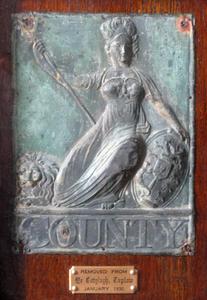 Other interesting facts come to light when researching such an old property. One of these is the history of the Fire Insurance Wall Plaques, or firemarks. One of these was removed from the wall of Old Cottage in 1930 and the then owner had the foresight to have it framed and it now hangs on the wall of my entrance hall. It is made of metal and shows the figure of Britannia and bears the inscription 'Removed from Ye Cottleigh, Taplow, January 1930' with the word 'County' below this. In early days people who lost their homes and all their possessions through fire became destitute and had to rely on charity to survive. After the Great Fire of London in 1666 it became obvious that some system of indemnity against such disasters would have to be found. Thus the birth of insurance companies. The early companies originally served only the London area but gradually extended their business to cover the whole country. The metal fire plaques - or firemarks as they came to be known - were needed for identification purposes if a building was totally destroyed and the owners needed to be able to prove that they were insured with that particular company. As insurance companies began to introduce written policy documents the use of firemarks died out during the 19th century. All the different companies had their own firemarks bearing their different logos and, interestingly from my point of view, among these were a Sun Insurance Company and a Royal Insurance Company. The County Insurance Company was absorbed into the Alliance Company in 1906. This then became the Sun Alliance Group - which is now the Royal Sun Alliance company, which insures the Old Cottage to this day.
In the Kelly Directory of 1930 the name Ye Cotteigh is still shown - occupied by a Mrs Dorsett - under the heading 'The Village' as there were no road names here at that time. The names of the owners are listed in alphabetical order, headed by Lord Desborough shown as owner of Taplow Court. Walter de la Mare was living in Hill House and a Mr Lester, Clerk to the Parish Council, lived in The Nest which I am reliably informed was the name of the house we now know as Victoria Cottage. In 1936, Lady Constance Butler is listed as owner of Ye Cottleigh. She was still living there in 1942 but the house is now referred to as Old Taplow Cottage. In 1948, Lady Pole-Carew was in Old Taplow Cottage and was still there in 1952 though this entry refers to the High Street. The records for this period are incomplete so I cannot get any closer than that to the exact date when it was considered necessary to affix names to these roads.
Old Cottage has been altered many times during its long life and was certainly divided into two dwellings for much of its earlier life. It is a delightful and tranquil place in which to live and, although an old resident who had lived here all his life once told me that the small end part on the west side had been owned at one time by a coffin-maker who used to sleep in his coffin every night to save the undertakers trouble if he was taken in the night, I have had no feelings of unease here; if there are ghosts, they are obviously benign. The need for constant repair and renewal never comes to an end with a property of this age but it is a home of real charm and historical interest as I have endeavoured to show here and it makes a very comfortable and welcoming home.
I must acknowledge that some of the details about Maryfield were supplied by an article written by Leonard Miall for this newsletter some years ago and I wish to thank Helen Grellier for her historical knowledge and for pointing me in the right direction for some of my research.
Pamela Bentley
Other interesting facts come to light when researching such an old property. One of these is the history of the Fire Insurance Wall Plaques, or firemarks. One of these was removed from the wall of Old Cottage in 1930 and the then owner had the foresight to have it framed and it now hangs on the wall of my entrance hall. It is made of metal and shows the figure of Britannia and bears the inscription 'Removed from Ye Cottleigh, Taplow, January 1930' with the word 'County' below this. In early days people who lost their homes and all their possessions through fire became destitute and had to rely on charity to survive. After the Great Fire of London in 1666 it became obvious that some system of indemnity against such disasters would have to be found. Thus the birth of insurance companies. The early companies originally served only the London area but gradually extended their business to cover the whole country. The metal fire plaques - or firemarks as they came to be known - were needed for identification purposes if a building was totally destroyed and the owners needed to be able to prove that they were insured with that particular company. As insurance companies began to introduce written policy documents the use of firemarks died out during the 19th century. All the different companies had their own firemarks bearing their different logos and, interestingly from my point of view, among these were a Sun Insurance Company and a Royal Insurance Company. The County Insurance Company was absorbed into the Alliance Company in 1906. This then became the Sun Alliance Group - which is now the Royal Sun Alliance company, which insures the Old Cottage to this day.
In the Kelly Directory of 1930 the name Ye Cotteigh is still shown - occupied by a Mrs Dorsett - under the heading 'The Village' as there were no road names here at that time. The names of the owners are listed in alphabetical order, headed by Lord Desborough shown as owner of Taplow Court. Walter de la Mare was living in Hill House and a Mr Lester, Clerk to the Parish Council, lived in The Nest which I am reliably informed was the name of the house we now know as Victoria Cottage. In 1936, Lady Constance Butler is listed as owner of Ye Cottleigh. She was still living there in 1942 but the house is now referred to as Old Taplow Cottage. In 1948, Lady Pole-Carew was in Old Taplow Cottage and was still there in 1952 though this entry refers to the High Street. The records for this period are incomplete so I cannot get any closer than that to the exact date when it was considered necessary to affix names to these roads.
Old Cottage has been altered many times during its long life and was certainly divided into two dwellings for much of its earlier life. It is a delightful and tranquil place in which to live and, although an old resident who had lived here all his life once told me that the small end part on the west side had been owned at one time by a coffin-maker who used to sleep in his coffin every night to save the undertakers trouble if he was taken in the night, I have had no feelings of unease here; if there are ghosts, they are obviously benign. The need for constant repair and renewal never comes to an end with a property of this age but it is a home of real charm and historical interest as I have endeavoured to show here and it makes a very comfortable and welcoming home.
I must acknowledge that some of the details about Maryfield were supplied by an article written by Leonard Miall for this newsletter some years ago and I wish to thank Helen Grellier for her historical knowledge and for pointing me in the right direction for some of my research.
Pamela Bentley