
Archived Page
This page is no longer maintained.
For up-to-date information please see the
new website
Third Runway Update
Sadly, as I predicted when I wrote the last piece on runway alterations and additions, it now seems almost inevitable that the Government, aided and abetted by BAA, are going to see that more new runways are going to be built in the South of England. Before dealing with Heathrow, which is of course our major concern, it is just necessary to comment on Gatwick and Stansted, as both have a bearing on what happens at Heathrow. There is a plan to build a new runway and a new terminal at Gatwick Airport in 2019 if plans to construct a third runway at Heathrow fall foul of EU pollution controls. So far as Stansted is concerned, it is said a second runway at Stansted Airport would be 'economically unviable' without cross-subsidisation from Heathrow and Gatwick, according to leaked Treasury documents. Currently against cross-subsidisation of airports, the Civil Airports Authority, which is the industry regulator, would need compelling evidence to change its mind. With no subsidy, the new Stansted runway could put £10 on ticket prices and would massively reduce the profits of low-cost carriers, possibly ruining the airport's future. Now, to Heathrow. The latest information is contained in a BAA Heathrow publication dated spring 2007 and it states: 'The government’s progress report on the 2003 air transport White Paper has confirmed its commitment to increasing Heathrow’s runway capacity. Both increasing the number of flights by introducing Mixed Mode [this means ending runway alternation] or building a third runway would only go ahead if tough environmental standards can be met. Tony Douglas, CEO of BAA Heathrow, said: 'Both of our runways are full, operating at 98.5% of their permitted capacity. Competitor airports in Europe such as Frankfurt, Paris CDG and Amsterdam each have between three and five runways, and all operate at less than 75% capacity. Yet the continued success of Heathrow depends on our ability to remain a leading hub airport. 'Heathrow plays a unique role in the competitiveness of London and the UK. It supports hundreds of thousands of jobs, provides vital links between the UK and the global economy and,and is an essential factor in convincing companies to locate here. 'Heathrow operates the UK’s only direct air links to key emerging world markets and more than half of all the UK’s air freight passes through Heathrow. 'Some 90% of businesses in London and around Heathrow rate the airport as either "vital" or "very important" to their business.' However Tony did add, 'The expansion will only go ahead if local environmental impacts can be minimised. This means no more noise than in 2002, all air-quality pollution safely within EU limits, and public transport improvements to reduce congestion.'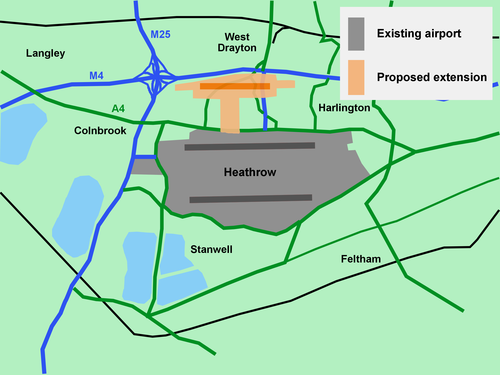 A third runway at Heathrow is highly controversial. Department of Transport studies suggest a third 'short' runway (2000m as opposed to 4000m) could be constructed to the north of Heathrow, with additional terminal capacity provided by a sixth terminal. The third runway would be constructed adjacent to the M4 motorway and would involve significant property demolition (260 buildings) and would use 23 hectares of Green Belt. The villages of Sipson and Harmondsworth would essentially be demolished to make way for the new runway and terminal buildings.
The environmental impact
Currently, a cap of 480,000 air transport movements per annum is imposed on Heathrow to reduce the effects of noise and pollution (this was one good result of the Terminal 5 enquiry). A third runway would mean exceeding this cap; the DfT study suggested removing this cap but retaining the 'noise contour cap' of 145 sq km. This means that noise is only allowed to reach a certain level over a specified area around the airport. It is also expected the increased traffic would worsen levels of pollution from the M4. However, a recent scheme suggests putting the M4 in a tunnel past Heathrow to overcome the excessive pollution should there be a breach of EU pollution targets.
Airport capacity
Today's forecasts show that use of the airport will rise from its current level of 64million passengers per annum (mppa) to the airport capacity of 89mppa by 2030 (this includes capacity created by Terminal 5. Adding a runway would increase capacity to 116mppa and air transport movements to 655,000. As you can imagine, all the local councils and some vociferous campaign groups are opposed to the expansion of Heathrow in this way.
On a lighter note to end: work has begun on the test track for the world’s first Personal Rapid Transit (PRT) system, which will run between the N3 car park near Longford village and Terminal 5 and will benefit local residents as well as Heathrow passengers. The PRT consists of small cars with rubber tyres that travel along a guideway. The system has a number of great advantages, including the fact that, being battery powered, it is extremely quiet – 'no louder than a normal conversation at 10 metres', they say... Depends who is talking, doesn’t it!!
Derek Walker
A third runway at Heathrow is highly controversial. Department of Transport studies suggest a third 'short' runway (2000m as opposed to 4000m) could be constructed to the north of Heathrow, with additional terminal capacity provided by a sixth terminal. The third runway would be constructed adjacent to the M4 motorway and would involve significant property demolition (260 buildings) and would use 23 hectares of Green Belt. The villages of Sipson and Harmondsworth would essentially be demolished to make way for the new runway and terminal buildings.
The environmental impact
Currently, a cap of 480,000 air transport movements per annum is imposed on Heathrow to reduce the effects of noise and pollution (this was one good result of the Terminal 5 enquiry). A third runway would mean exceeding this cap; the DfT study suggested removing this cap but retaining the 'noise contour cap' of 145 sq km. This means that noise is only allowed to reach a certain level over a specified area around the airport. It is also expected the increased traffic would worsen levels of pollution from the M4. However, a recent scheme suggests putting the M4 in a tunnel past Heathrow to overcome the excessive pollution should there be a breach of EU pollution targets.
Airport capacity
Today's forecasts show that use of the airport will rise from its current level of 64million passengers per annum (mppa) to the airport capacity of 89mppa by 2030 (this includes capacity created by Terminal 5. Adding a runway would increase capacity to 116mppa and air transport movements to 655,000. As you can imagine, all the local councils and some vociferous campaign groups are opposed to the expansion of Heathrow in this way.
On a lighter note to end: work has begun on the test track for the world’s first Personal Rapid Transit (PRT) system, which will run between the N3 car park near Longford village and Terminal 5 and will benefit local residents as well as Heathrow passengers. The PRT consists of small cars with rubber tyres that travel along a guideway. The system has a number of great advantages, including the fact that, being battery powered, it is extremely quiet – 'no louder than a normal conversation at 10 metres', they say... Depends who is talking, doesn’t it!!
Derek Walker