
Archived Page
This page is no longer maintained.
For up-to-date information please see the
new website
Re-Thatching the Thatched Cottage
Brenda Burns
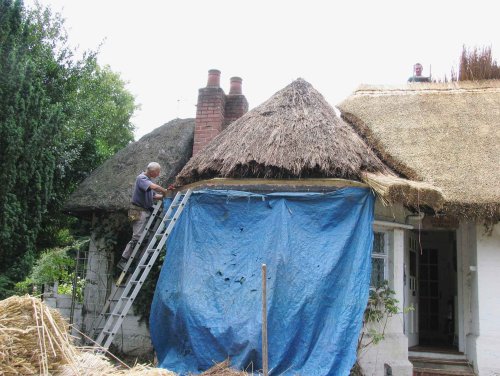 Many of you will have noticed the work being carried out at the Thatched Cottage in Berry Hill owned by Brenda and wondered that the skills to do such work are still around, even to still having apprentices, in this case David, a college undergraduate. What follows is the essence of a talk Brenda gave to the Women’s Institute. The cottage seems to go back to the 1700s and I have a lot of material about its history and its intertwined relationships with the great houses over the years that will have to wait for the next Newsletter owing to lack of space in this issue. Ed.
The two master thatchers and an apprentice, Glen, Barney and David, arrived at dawn early in June complete with bales and bales of beautifully combed golden wheat-reed and many of their interesting tools - metal cradles, which hook onto the thatch to hold the bales, metal and wooden square bats called leggats to tap in and smooth the ends of the reed, spars of hazel wands pointed at both ends which are soaked in water then twisted and bent to to hold the bales in place. they also had rakes, a belt of small tools and masses and masses of pink binder twine for every use under the sun!
Many of you will have noticed the work being carried out at the Thatched Cottage in Berry Hill owned by Brenda and wondered that the skills to do such work are still around, even to still having apprentices, in this case David, a college undergraduate. What follows is the essence of a talk Brenda gave to the Women’s Institute. The cottage seems to go back to the 1700s and I have a lot of material about its history and its intertwined relationships with the great houses over the years that will have to wait for the next Newsletter owing to lack of space in this issue. Ed.
The two master thatchers and an apprentice, Glen, Barney and David, arrived at dawn early in June complete with bales and bales of beautifully combed golden wheat-reed and many of their interesting tools - metal cradles, which hook onto the thatch to hold the bales, metal and wooden square bats called leggats to tap in and smooth the ends of the reed, spars of hazel wands pointed at both ends which are soaked in water then twisted and bent to to hold the bales in place. they also had rakes, a belt of small tools and masses and masses of pink binder twine for every use under the sun!
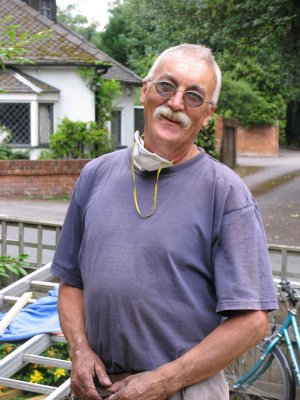 The first job was to remove the old wire netting covering the thatch then came the filthiest job imaginable - donning their protective face masks and knee pads they raked off the old thatch (dust and straw everywhere) I have raspberries 25 yards away and they became a very strange colour. The squirrels had left empty holes where they had stolen straw, birds and mice had nibbled themselves more holes. Seven dead wasps nests emerged plus one new nest, which had to be dealt with pronto of course.
The real skill of the craft came next, the large golden bales were banged and banged on a hard surface to make the cut ends of the wheat level and even. the bales were then divided into smaller ones and tied in the middle with twine. The first layer called ‘bottles’ form the overhang of the thatch is laid on an under-roof (flatcoat) on battens about a foot wide.
The first job was to remove the old wire netting covering the thatch then came the filthiest job imaginable - donning their protective face masks and knee pads they raked off the old thatch (dust and straw everywhere) I have raspberries 25 yards away and they became a very strange colour. The squirrels had left empty holes where they had stolen straw, birds and mice had nibbled themselves more holes. Seven dead wasps nests emerged plus one new nest, which had to be dealt with pronto of course.
The real skill of the craft came next, the large golden bales were banged and banged on a hard surface to make the cut ends of the wheat level and even. the bales were then divided into smaller ones and tied in the middle with twine. The first layer called ‘bottles’ form the overhang of the thatch is laid on an under-roof (flatcoat) on battens about a foot wide.
 This is the bit that drips on one after rain (no gutters!) The thatcher places about four bales side by side - the width of his stretched arm - and each one of the first layer is tied and secured to the fascia board, then the ones above are tied by plaited reed and secured individually by the spars of bent and twisted hazel. The thatching is done upwards to the ridge, always starting at the bottom overhang layer. The plaiting at the ridge is much more ornate and is Barney’s special skill. There were four separate thatches to be done, the smaller one at the front was very worn and had developed into a real mess. the thatchers had to do quite a bit of carpentry to renew the wooden battens and now it looks splendid.
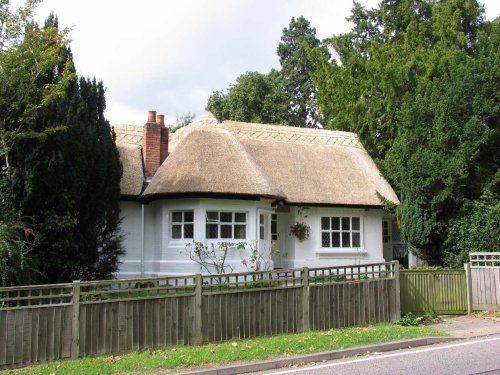
The garden was covered in straw for weeks but the thatchers did a wonderful job of clearing up. Once the thatch is finished the edges have to be cut straight - a tricky job. The thatch is then brushed and patted all over and the final job was covering the four separate thatches with wire netting and fastening it all securely to the wooden fascia.
This is the bit that drips on one after rain (no gutters!) The thatcher places about four bales side by side - the width of his stretched arm - and each one of the first layer is tied and secured to the fascia board, then the ones above are tied by plaited reed and secured individually by the spars of bent and twisted hazel. The thatching is done upwards to the ridge, always starting at the bottom overhang layer. The plaiting at the ridge is much more ornate and is Barney’s special skill. There were four separate thatches to be done, the smaller one at the front was very worn and had developed into a real mess. the thatchers had to do quite a bit of carpentry to renew the wooden battens and now it looks splendid.
The garden was covered in straw for weeks but the thatchers did a wonderful job of clearing up. Once the thatch is finished the edges have to be cut straight - a tricky job. The thatch is then brushed and patted all over and the final job was covering the four separate thatches with wire netting and fastening it all securely to the wooden fascia.